Tuesday, 29 May 2018

Preparing for the Ration Challenge (3)

In Challenge Land this week has been epic!

Due to my wonderful whanau and friends and an amazing anonymous donor I have made my personal fundraising target.


AND we've made our team target already!  In fact, they have a new function on the website which is a 'leaderboard' of how well individuals and teams are doing*.  And randomly, our team is in sixth place!  This is all down to our amazing sponsors.  While everyone says 'wow!  That's an amazing thing you're doing' - the reality is that the difference made (in terms of Zaatari Camp) is by those who support me, and the other challengers, in doing this.  Thank you everyone who has supported me in this challenge.  You are helping real people with great need and it is wonderful.

We made the leaderboard!

Between us, the amount Sonali and I have raised is enough to feed five refugees for one year!  At this point in time the Ration Challenge NZ has collectively raised enough to feed 794 refugees for a year.  This is only about 1% of the number of people in the Zaatari camp.  So it is just a drop in the pan.  But that is 794 people that would otherwise be struggling to feed their families.  It is a big difference in the lives of those individual people.


And so, because I know how great the need is I am changing our targets.  I would rather try at something bigger and fail, than be complacent with what I have when there is still so much time left. So I've upped my personal target to feed four refugees for a year.  And the team target now reflects that change.  So of course, if you are yet to donate and would like to, you can!  Just click here to go to my donation page.

I am starting to feel more anxious about the challenge itself.

The truth is, while I try to eat healthy, I am a slave to flavour.  I will have a delicious dinner and then follow it up with some salt n vinegar Peckish Thins.  At this time of year I am often found rocking a hot toddy to cure the creeping cold ails.  Same goes for herbal teas.  While I have tried a lot of the foods I will be eating during the challenge and am finding them ok - the reality of living on such simple fare, and in limited quantities is daunting.

So my next post will focus on the things I will do during the challenge time to manage myself and my feelings - as while I've been great with thinking about the food stuff - I haven't thought much about self-care or management during this time - which is just as important a factor.

*         *          *         *         *          *         *         *          *         *         *          *        

Recipe time!

So I tried making a few dinner things for the challenge.  I probably won't make these to go together - I think the lentil soup will be better with just plain rice rather than the cakes - but I want to be able to mix things up for the challenge so I don't feel bored or resentful.  The first recipe is an adaptation of one from the Ration Challenge Guide.

 Lentil soup - made about three cups worth!     
Lentil Soup 

170g lentils
100mls milk
1/2 tsp brown sugar
Seasonings to taste
 
1) Wash the lentils until clean.  Cook in plenty of water, simmering for about half an hour.  Drain most of the water off.
2) Blitz the lentil mix with a slender blender.  Add milk and sugar and seasoning to taste.
3) Serve with rice

This soup was surprsingly good!  And the yield was enough for - I think - a decent dinner portion and two half size lunch portions.  Because I have some other foods aside for lunch too, I think this will be filling enough to get me through those two days at least.  So that feels like a really good start in terms of delicious dinners.

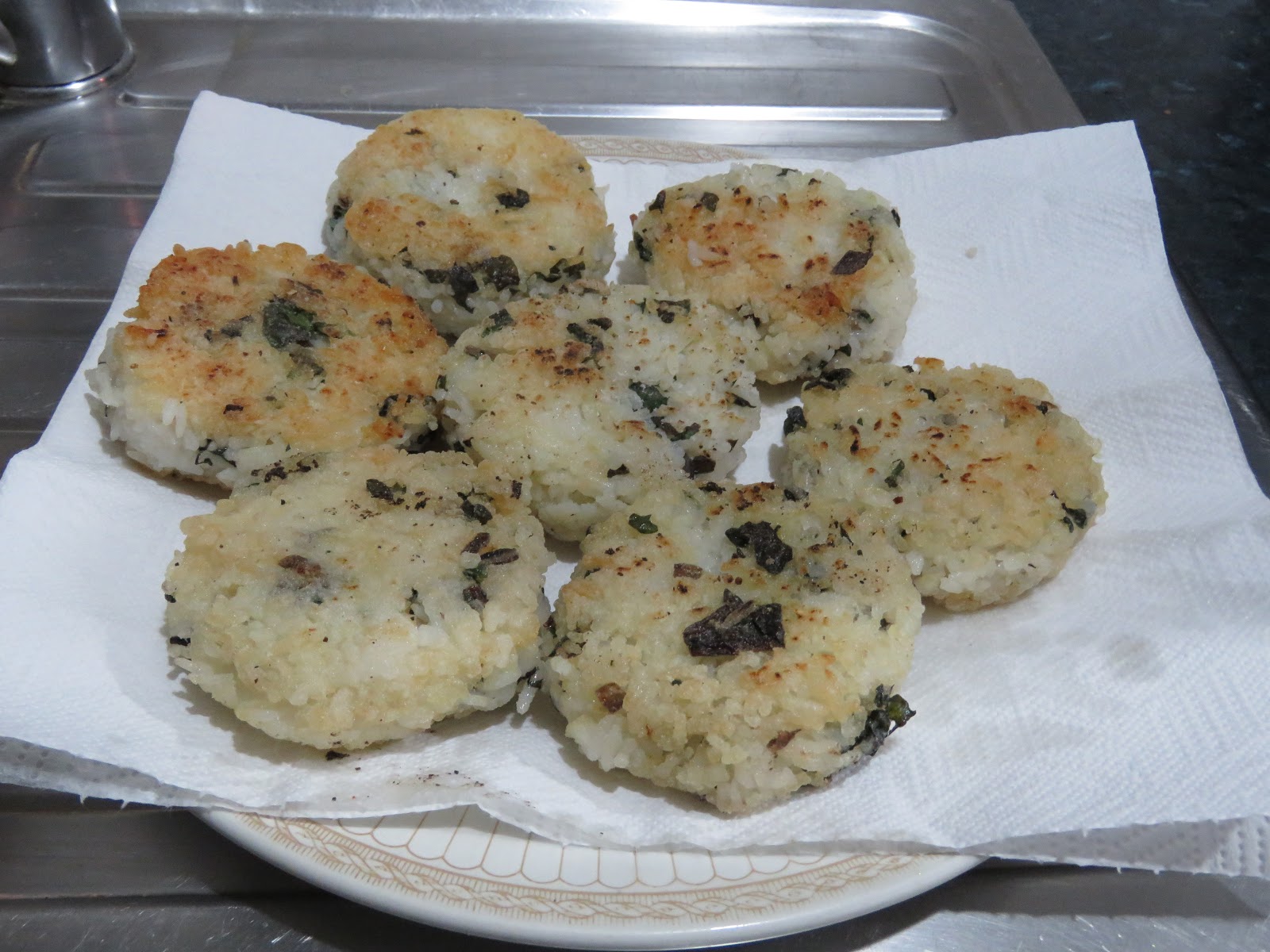
Yummy rice cakes

Fried Rice Cakes
1 cup rice seasoned with salt
Silverbeet finely chopped (or any other vegetable in small quantity)

100mls oil (you can use less)
1 TBSP gluten free flour
Seasonings to taste
 
1) Cook rice as you usually would.  Allow to cool.
2) Add finely chopped veges.  Form into small patties with your hands and roll on a plate in the gluten free flour mix (I add the seasonings to the flour)
3) Make sure the oil is at perfect frying temperature (hot!) in a small frying pan.  I fried mine in batches of about three.  Cook each side until they start to turn brown (about 3 - 5 minutes) then turn.
4) The mix makes about 6 - 8 rice cakes depending on how big you want them.
5) Drain on paper towel (if available)

These were yum!  I think if I were doing them over I would have made them a little thinner and made one or two more of them.  They would be great to dip in sauce or stew, or would make a nice small lunch with hummus.

One Ration Challenge meal serving.


* I am of two minds about it.  I think it's great in that it encourages competition which at the end makes a bigger difference for those we are trying to help.  But I also feel maybe it will make those struggling to fundraise feel more badly about their position.  I believe that every bit counts - every Ration Challenger counts - even if they only manage their own self sponsorship.  They are putting their tummies on the line to highlight this refugee community.  And that in and of itself is huge.

Thursday, 17 May 2018

Preparing for the Ration Challenge (2)

Today marks exactly one month until the start of the Ration Challenge!

And even though I post about this every week, every week a lot changes.  This week I had a big change.  I started a team.  Starting a Ration Challenge Team is hard when you don't actually know any other people doing the Ration Challenge.  And hard when you have social anxiety.  But I thought - what have I got to lose?  And I asked a random lady who had commented on the Ration Challenge Facebook page if she wanted to form a team with me.  And she said yes!  Then I asked a lady in one of my Mummies forums - she also said yes (but I haven't heard from her since...)

So anyhow - I am now in a team of two which feels awesome!


Our fundraising team page - The CompassionAtes

Because now I am not doing this on my own!  My team mate, Sonali, lives on the North Shore.  And even though meeting new people makes me super anxious - we are actually going to meet during the week of the challenge!  It will be nice to have someone to talk to that is also experiencing the difficulties of participating in this challenge.  And it will be nice to share a meal with someone during this week.  Actually, this is an amazing opportunity to meet someone I never otherwise would, just because we believe in the same principle of helping others.

The other news this week is that I am 2/3rds of the way to achieving my fundraising goal.  Which makes me believe I will achieve it - and possibly even more?  If I raise $864 I can pay for a child's education for a whole year!  And if I raise $1024 those funds can feed four people in the Zataari Camp for a whole year!  That would be amazing.  And every little bit that is donated counts.  So far, in its inaugural year in New Zealand the Ration Challenge community has already raised more than $114,000 which is enough to feed 445 refugees for a whole year.  And it's still a month away from the actual challenge!

So I want to say thank you so much to everyone who has donated to the Ration Challenge so far.  Whether your donation has been small or large, every bit of it helps these folk who through no fault of their own face massive challenges every day.  And if you've sponsored me, you have also helped me gain some rewards to make this challenge a little easier.  So far your contributions have got me some the following extra bits and pieces:
  •  50 grams of sugar
  • 210mls of milk                     This is 170g of carrot - the other vege I am considering.
  • 170 grams of a vegetable  
A vegetable!  This is amazing!  I would have struggled without this boost.  170 grams is not a lot, but it is enough to make a difference to both my energy levels and my frame of mind.  I am as yet undecided on what vegetable to choose.  I have strongly been considering carrot as I can make a nice carrot and lentil soup and cut the remainder into little strips for teeny sweet snacks during the day.  But it will most likely be rainbow silverbeet from the garden.  Leafy greens you get more bang for your buck weight wise.  Plus having stems and leaves make for two different textures for more variety.  And rainbow silverbeet equals colour which equals antioxidants which equals more happiness.  Well, that's my theory anyway. 

The other awesome thing is that as a team Sonali and I have each raised over $350, which gives us a team bonus of either an extra 100mls of milk or 25 grams of sugar each.  Which really is helpful!  I think I will be going with the milk as the extra protein will be helpful in helping me survive the days better.  And of course, if either of us makes it to a reward level the other hasn't by the 17th of June, we can share the extra we have with each other.

The other benefit of being in a team is that we get to pool our unlimited spices!  I let Sonali choose the combo so we are going with salt and lemon pepper.  While I had not even considered lemon pepper I do see a lot of potential here so am starting to feel excited about her choice.  And if anyone else wants to do the challenge and/or decides to join our team we may even have even more variety and more people to share ideas, feelings and recipes with.

If you want to sponsor me, just click here.  Or if you don't have credit card/are struggling with the website, just PM me and we'll work it out.

*           *           *          *           *           *           *           *           *           *           *           *           


Recipe time!

So I measured out how much flour I will have for the challenge, deducted what will be used for my cookies and divided the rest roughly into seven.  This gives me about 1/4 of a cup per day to use for flatbread (plus an extra 1/2 cup to be used as needed on tougher days).  I decided to base my recipe on Fatima's recipe from the Ration Challenge Guide.  So my recipe is:

Gluten Free Flatbread

1/4 cup gluten free flour mix
enough water to mix to a smooth dough
A little salt to taste
1/2 tsp oil to fry flatbread in.

1) Mix the flour, salt and water to make a firm dough.  Knead for 2 - 3 minutes.
2) Leave to rest covered with a damp cloth for 10ish minutes
3) Flatten your flatbreads into super flat rounds - I reckon the flatter the better.
4) Heat a small frying pan to a medium high heat (I use the second to highest second) and fry until starts to brown, then turn and cook the other side the same.
5) Cut into triangles and serve with whatever you have available.

Next to a teaspoon for comparison.
I rolled the next one flatter so it was a little bigger.

I have made these twice and the visual difference between my gluten free version and the regular version is quite apparent.  I made both versions yesterday to go with our chickpea curry.  I didn't try the regular flatbread, but Murray tried both and reckons in spite of the visual differences they actually taste similar.  And I think it's ok.  Not super delicious, but ok.  

But 1/4 of a cup makes just one small flatbread.  These test cooks are helping me realise how difficult this week is actually going to be.  These flatbreads with hummus and rice are going to be my version of taking sandwiches to work that week.  It's not a lot.  If I have enough leftovers from my planned dinners I will take some of those too.  But looking at the number of lentils in the bag and the 105 grams of vegetarian mince I have (what I've replaced the sardines with) I don't think there will be much.  But knowledge is power, and I feel these test cooks are helping arm me with skills for the challenge ahead in June. 

In this instance, the kids did not like the challenge food at all.  Etta deigned to put a teeny sliver in her mouth and chewed and spat it out, and Abby wouldn't even put it in her mouth.  Oh well.  I can't win them all.


 A breakfast bowl of flatbread.  Small, but reasonably delicious.

Sunday, 13 May 2018

On Mothers Day and Kindness

So it is Mothers Day today.

And I am a horrible, cynical person who works in retail - so it's hard for me not to see it as much more than a marketing ploy.  Nevertheless, I do think it is nice that we have one day a year to recognise all that our mothers do for us and all that the mothers in our communities do for their families.  And for those of us who are Mums ourselves, it is nice to have a day where we might just feel appreciated for all that we do.

When you work in a department store
it's hard not to be cynical       
(and yet still I bought Mums present here...)

It is difficult not to fall into the trap of buying gifts for Mothers Day.  As a beneficiary with longterm illness, my Mum doesn't have a lot, so I do feel like Mothers Day is an opportunity to get her nice, useful things.  But many Mum's are not in the same position as mine.  I am one of those Mums.  So every time my lovely partner says 'what do you want for Mothers Day?' I am kinda stumped.  I know the kids will make me a card, and that'll be lovely.  But there are no present type things I really need.  I do need undies, but I suspect I will be better at picking comfortable ones (and for me, comfy undies  are a MUST HAVE) than either Murray or the kids, so I'd rather just get them myself.

And while what I'd really like for Mothers Day is a lie in, time to myself, big cuddles and a lovely meal I haven't cooked myself, like many mothers who work retail, I will be working today.  Consequently, doing all of those things today is just not possible.  And Murray usually cooks on Sundays anyway, so a nice meal I didn't cook is just a regular Sunday dinner.  So after thinking about it over the last few days I realised what I really wanted for Mothers Day was to show kindness to mothers and children who have greater need than me.

A big part of why I am doing the Ration Challenge is that I want my kids to see the impact kindness can have on others lives.  When I did the Circle Of Security parenting course one of the questions they asked at the outset was to list three qualities you most want for your children.  At the top of my list was kindness.  There is no such thing as a perfect parent and I am certainly not an all-rounder at this parenting bizzo*.  But the one thing I will work desperately to instill in my kids, is the importance of being kind.

Because I truly believe that through showing kindness and compassion for all people, we can make this world a better place.  So I try to exercise this every day.  It is in the little things - thinking before we speak, apologising when we say something wrong or hurtful unintentionally, learning from our mistakes - and just lending a hand when we can.  With my kids it's about listening to them, working on solutions to problems together and noticing when they need a little boost or a lot of cuddles.  And I am not perfect at this either.  But I work hard to be better at it.  And while there are many folk in need of a tonne of kindness right here in our neighbourhood**, I do think it is important to look at the bigger picture to really put things in perspective.

Currently we are witnessing the highest amount of displaced people worldwide on record.  Etta knows what war is.  I think it was the ANZAC Ted book she got last Christmas that prompted this discussion.  She is a curious kid and we have tried our best to answer her questions honestly and in an age appropriate way.  Having a context in which to explain what being a refugee means helps her to better understand the long term effects of war.  This also helps her to recognise her own privilege, and gives her more tools to live a compassionate life.  And Abby is little, but even so she will be absorbing more of this than we think.

The kids hitting the 'donation' button with Dad.
Who doesn't love pressing buttons?


Were the kids keen on giving Mum some seemingly intangible thing rather than something they chose themselves?  No, they were not.  Regardless of their lack of understanding, it gives them an idea of just how much we value helping others.  And through doing the prep work for the challenge and the discussions that consequently come up in our home, we reaffirm to them just how important we feel it is to work hard to help others.

I cannot comprehend what it would be like to be a mother during a state of war.  I cannot really comprehend war.  I don't know how I would cope with the loss of independence that comes with losing ones home, family and country, nor how I would swallow my pride to accept support from strangers.  But I do know that as parents we adapt to the unexpected situations that face us, because we have little choice but to do so.

There are many, many refugee mothers and children in this world, especially in Jordan where many Syrian refugees have sought asylum.  This breaks my heart.  And while I know I cannot singlehandedly stop a war and rebuild a nation, I believe that collectively we have the power to improve the lives of those affected by the displacement of war.  And as a mother, I empathise with the struggles of other Mothers, whether I fully comprehend them or not.  It doesn't matter if it's a Mum from Kindy, a Mum in my family or a Mum on the other side of the world.  The truth is the end goal for us is largely the same - trying to do what is best for our families***.


A Syrian family in Zataari Camp receiving their ration pack.

I have chosen to put my empathy into action via The Ration Challenge which is running in New Zealand for the first year this year.  This is a fundraiser, and awareness campaign for those living in the Zataari Camp in Jordan, where, for one week, participants eat the same rations as a Syrian refugee.  Funds are used to provide desperately needed things like food, sanitary items, medicine and education.  Of course, there are other ways you can help refugee families closer to home through non-monetary means.  You can volunteer to help refugee families settle into New Zealand life, or donate household goods to help these families get started.

I know this post has become exactly what I cynically said Mothers Day was all about - marketing.  And of COURSE I'd love for more people to sponsor me for the Ration Challenge**** or to take up the charge and get on board themselves.

But the real purpose for this post is promoting kindness.  I feel so grateful to live a life that is just teeming with kind, amazing and supportive Mums.  And I feel so grateful for my Mum, who is one of the kindest people I know.  Having all these wonderful Mothers around has made my transition to motherhood a lot less scary.  I'd love to see more of us extending that kindness to Mothers outside of our Kindy, our families and our Facebook groups, because not everyone is as lucky as I, and maybe you, are.  Sometimes all that kindness requires, is a warm 'I get it' smile at a stranger when their kid is melting down at the playground.

Collectively, we are wiser and stronger, and kindness forges that connection.

Happy Mothers Day.


My lovely Mothers Day card from Etta
made with help from her lovely Kindy teachers.
And just FYI, I do not give her thousands of toys.

* Having anxiety does make some aspects of parenting tough.  And I am not great at messy play, rough-housing or silly play with the kids.  Luckily, I have a Murray (my partner) who is GREAT at being silly and rough-housing with the kids, and a Mum who is great at messy play.  I figure having a super team of grown ups that are good at different things makes things better for everyone.

** The at home charity we regularly support is Kidscan as child poverty has a massive affect on us both here in NZ, and directly in our local community (Etta's school is one which receives support from Kidscan)

*** And of course, we are a part of that family - self care is as important as the care of any other family member.  Be kinder to yourselves Mummies!  Treat yourself with the same care, love and respect you give to others.

**** If you can't see my hyperlinks for any reason, and you do want to sponsor me - just go to https://my.rationchallenge.org.nz/hannah-may


Also, ignore the recommended donations if they look too crazy - they are quite high!  Every little bit counts - just $5 will feed a family at the Zaatari camp for one day, which still makes a huge difference.

OR to be kind to a total stranger just click on the 'sponsor someone' link on the Ration Challenge hub, search a random first name and sponsor whoever shows the lowest fundraised amount.  It all goes to the same place in the end!

Wednesday, 9 May 2018

Prep for the Ration Challenge: My Ration Pack arrived!

So I knew how much food I had to eat before I decided to do this challenge.  But when it actually arrived in its tiny box, I was still a bit shocked - there is just so little of it!  Even though I'd seen in in photo-form, I assumed that the amount of lentils and chickpeas would be more than sufficient.  But when I saw them in person, when I took them out of that tiny box and laid out on my table at home, I realised how misguided that idea was.


Not pictured here: 400g of tofu (as opted out of included sardines)

Once I added in the extra's I've 'earned' as rewards for reaching certain sponsorship levels, it looks a little better.  And if I imagine the vouchers as actual food quantities, that seems a little better again.

including the rewards - unlimited cumin, 1/4 cup brown sugar and 210 mls of milk

To be honest, seeing this makes me feel a little more nervous about participating in this challenge.  I love to cook and our dinners usually comprise of complex spice blends, rainbows of vegetables and assorted condiments.  This food is not only a smaller quantity than I envisaged, but seeing it actually there I realise just how simple it is.
 
There are no fruit or vegetables here - not a single green thing.  This is a huge reminder of how lucky we are here in New Zealand.  If I walk outside I can gather a nutritious and flavourful wild greens salad of nasturtium, puha and dandelion greens - and that's not including the herbs and greens in our actual garden.  Zaatari Camp is in desert - there is no green space, only dust and rocks.  A community park is in the plans for the camp, but has been put on hold due to lack of funds.  Imagine the difference green space could make to people living in a place like this!  But when they have so little to eat, and an ever increasing community, it is easy to understand why this is not top priority.


A comparison of the ground at Zaatari Camp and my front lawn.

It also reminds me of the privilege of choice.  As a former vegetarian, my regular diet is high in vegetables.  Our pantry is stocked with at least four different types of rice and at least three other gluten free grains.  We have six different oils for cooking and medicinal use.  Whilst I do exist on a restricted diet to manage my health issues* (low FODMAPS, and no red meat) I manage to not feel resentful about it by diversifying and getting creative in the kitchen.  Doing this challenge reminds me of how lucky I am to not only have access to such a large assortment of foods, but the facilities and skills to use them to create delicious meals.

So this is going to be a very tough week!  At this point, I am feeling so grateful to have many wonderful donors behind me already.  Even though the actual challenge is a while away still, I am a wee bit of an obsessive planner.  Knowing before going in to the challenge that I get a few extra ingredients really helps me feel like I will be ok.  The addition of milk and sugar spread over a week ups my daily caloric intake by 140 kilojoules - which may make all the difference to me actually completing this challenge.

It is difficult to really understand living on such a limited diet indefinitely.  I am anxious about one week of it - would I, from my position of privilege be able to survive on it for a year?  Three years?  I don't know if I could.  I hope, that with the support of the broader community over time things can become easier for the families living at the Zaatari Camp.

*          *          *           *          *          *           *          *          *           *          *          *     

So on that note, today's recipe is all about getting something small and sweet into each day.  I invented this recipe using what I have available to me for the challenge.  And while my kids will eat them, I don't think they taste amazing.  They are a little hard, and the mix separates during mixing.  I am going to try with a different GF mix, because I think that's the main issue.  So I reckon if you want to give these a go, use regular flour (if you can) but these are probably best to make only if you are participating in the ration challenge yourself.  And you can if you want!  You have until the end of May to sign up, and you can use all and any of my recipes you like.

Basic caramel cookies

1/4 cup brown sugar (the entire sugar allotment)

1/2 Tbsp vegetable oil

2 Tbsp milk

1/4 cup and 1 - 2 Tbsp gluten free flour mix.
  • Add brown sugar, oil and milk to a small saucepan on a medium high heat.
  • Cook until bubbling and starting to thicken - take off the heat when the smell starts to change and the mixture begins to deepen in colour.
  • Add flour and mix to form a soft dough.
  • Roll and break of tea-spoon fulls and flatten into soft rounds.  Put onto a baking tray (I use baking paper as just means zero sticking issues.
  • Bake at 180 degrees Celsius for about 10 minutes or until starting to turn golden brown.
Makes about 14 tiny cookies (or two little blasts of sugary joy per day) 


  Even passed the Etta test!  She ate two.

* Adenomyosis, Endometriosis and IBS (which all often occur in conjunction with each other - I'm not just extremely unlucky).

Friday, 4 May 2018

Preparing for the Ration Challenge (1)

So I've decided to write regular posts in the lead up to The Ration Challenge.  Not only to raise awareness around what I'm doing and why, but also to share recipe ideas for the challenge itself.

So I thought to start with, I'd talk a little about my limited experiences with refugees.

The fact is, I've probably met a lot of folk from refugee backgrounds.  I know that one of my GP's fled the war in Iran with her family, for example.  But we've never really talked about it - it's not exactly something you just ask someone unless you know them very well.  So the only time I've openly spoken to someone of their experience as a refugee was at a wedding.

Some work by the iconic Misery (AKA Tanja Thompson)

Some years ago (12ish?) I went to an exhibition by Misery held somewhere on K Road.  I was headed there after going to some other thing, and by the time I arrived the friends I was meeting there were fairly hammered.  One had befriended this tall, friendly guy who spoke very little English.  His name was Bilal.  For a few hours, they were best friends, but as the alcohol wore off, Bilal was set adrift, so another (sober) friend and I took him under our wing.  My friend discovered she lived close to him, so dropped him home after, and then they became friends for real.

Bilal had come to New Zealand to learn English and experience life in a different (non-Muslim) culture.  He came from an affluent family in Jordan and was a qualified pilot. While his English wasn't great, he was a very social guy and worked in a pizza place on K Road.  He'd ended up at the exhibition purely because he'd heard people having a good time and wanted to see what it was all about.  Even though at times he thought us Kiwi's crazy, he welcomed us into his life, and his home - which put us in contact with the Somalian family he was staying with.

Hospitality is one of the main tenets of the Muslim faith.  Consequently, we were welcomed with warm smiles and sweet, milky tea.  So welcomed that we were invited to the niece of Bilal's host families wedding.  We were even given roles - as photographers (after they discovered we weren't so hot at doing bridal makeup), and traveled in a limousine* with the bridal party to the wedding.

For this particular community, men and women have separate celebrations - the legalities are performed between the brides father and the groom.  So the women have an epic hoolie with singing and dancing and drumming, while the men have a formal dinner somewhere up the road.  Because there are no men there, it is an opportunity for the women to let loose and really enjoy themselves, in their brightest sequinned flowing outfits.


A Somalian wedding dance - very similar to one performed at the wedding we went to.

It was during these celebrations that I met a woman missing two fingers.  Her name eludes me after all these years, but she was the most open and warmest women at the celebration.  She welcomed us white strangers in our drab garb and helped us understand what to do during the drumming, singing and dancing and answered all our questions.  She had divorced her husband because he abused her, and consequently, had her fingers chopped off.  Shortly after that, she fled her home with her kids and ended up here.  She didn't talk much about her journey here - just about how grateful she was to have her freedom, and about life as a modern, divorced Muslim woman in the New Zealand Somalian community.

I had seen people missing fingers.  But only men, and only due to war (my Great Grandfather) or industrial machinery accidents.  I had never met a woman who'd had her fingers brutally separated from her.  For trying to do her best for herself and her children.  I mean, I knew this stuff happened, but I never saw it, so the idea of it was more like watching a movie - distanced from reality.  Like anti-Semitism being an actual thing.  And Donald Trump.  Even though these issues are very real and very dangerous, in all honesty they feel distanced from my day to day life.

People scouring the debris of buildings after a strike by Syrian Government forces

And while this woman was from Somalia, and not from Syria - her story is not unlike theirs.  They have had to flee their home to survive, and for their families to survive.  And the largest camp holding them, is in the home country of the person who connected me to my first refugee story.  Bilal told me that if I went to Jordan I could stay at anyone's home - even a strangers -  for three nights because this was just the sort of hospitality expected in Jordan.  I am grateful to see them extending a similar hospitality to the refugees who have made it across the border.  And I'd love to offer my humbler hospitality to those in the camps there, so distanced from my life by doing a small thing to help provide food and education and the possibility of better things for them.  And I also hope that through doing this challenge, and understanding one aspect of refugee life, it helps me feel a little less distant.

*               *                *               *                 *               *                 *                *               

Now, I promised recipes...

I decided to start with something simple that uses the ingredient which will make up the majority of my diet over those seven days: rice.  And I decided to make a snack that is part of my usual diet on a regular basis: rice crackers.  I have never made rice crackers before.  In fact, I'd never even considered that you can make rice crackers before.  But I know I will want both something to snack on for this challenge, and something that is a normal part of my diet.  Because those things are both comforting.

So I found this recipe online and thought I'd give it a go.


Rice crackers - half plain, half parsley - an ingredient I am considering for one of my bonuses

I have substituted ingredients out for things I will have in the challenge.  So instead of coconut oil, I used canola oil.  And I didn't add any salt.  Sounds bland?  A little.  Nonetheless - they are crunchy, and I can pretend they are chips.  And they have the kids tick of approval - which is not easy to get!  Abby demolished her first two, then tried to sneak some more!  And Etta swallowed a small bite without too much complaint, which is high praise from her.  Abby said 'I like the green crackers best' so it's an easy way to get fresh greens into a kid too!   Murray was also a fan.  His feedback was: 'They are crunchy good and yum.'

So not only have I found something I can make for the Ration Challenge, but I've found something I can make for everyday snacks.  It's not too labour intensive, the kids can help make them, and is definitely healthier for the kids than the supermarket rice crackers.  They are cheap, and provide a lot of scope for flavour options outside of the Ration Challenge.  Murray has already said I will have to make an extra batch for the kids when I'm doing the challenge so that they don't nick mine as my limited resources will be precious!

Abby endorsing these home-made rice crackers (looks like a grimace, but that's her smile)


If you'd like to sponsor me for the Ration Challenge, just click here (ignore the recommended donation levels, give what you can).  If you'd like to participate in the Ration Challenge yourself, click here.  If you'd like more information of how you can help refugee communities here in NZ in non-monetary ways, click here.  And if you'd like to keep an eye out for more recipe posts from me, just watch this space!


* It is the only time I've ever been in a limousine

Saturday, 28 April 2018

On Choosing To Do The Ration Challenge


So after much deliberation I've decided to do The Ration Challenge in support of Syrian refugees in camps in Jordan.  The reason I had to really think this through was because it's going to be a super difficult challenge!  The ration packs are small and simple - they equate to about 80% of what an average adults caloric intake should be.  And because I have low blood pressure and other dietary restrictions (to help manage my endometriosis and adenomyosis symptoms) - this made me feel a little anxious.

But after much thought I realised that actually - I am in many ways the perfect candidate for this challenge.  I do not work full time.  I do not have a lot of extra curricula activities I cannot put on hold for a week to participate.  I have a very supportive family.  And this diet is just for one week.  For the people living in these camps - this has no known endpoint.  And they endure many, many other restrictions and face challenges daily that I cannot even comprehend.

My food supplies for one week

And I do have a lot of experience in learning new ways of cooking for restrictive diets - although these rations definitely provide the toughest challenge yet.  Thankfully, I am allowed to alter my rations to fit my dietary restrictions.  So I will swap out the sardines for tofu and the flour for a GF flour alternative.  Which leaves me with only one high FODMAPS item (kidney beans) which, if used sparingly in meals over the time period - should not make my pain flare up.

I will also be blogging and posting during the week of the challenge to give people some idea of the nature of the challenges faced eating this way.  I will be doing this from my comfy house which is warm and dry and not overcrowded, where I can watch Netflix and read in my comfortable bed - luxuries the refugees living on the same diet as me, will not have.  There are some great insights as to what their lives may look like here.

For me, this challenge is as much about raising awareness as it is about raising money.  I know that not everyone has money to give.  But everyone always has the capacity for compassion.  Being a refugee isn't really a choice.  It is either that, or face the possibility of death, or even worse atrocities for those fleeing their homes.  These people have done nothing wrong.  They are not taking the easy way out.  They are not trying to inconvenience others.  They are just trying to survive, and help their families also, survive situations beyond our comprehension.  I hope that in raising awareness of what they face, I can help people be more compassionate to the refugee families that live within our own communities.

I did not know about the Oxfam controversy when I signed up for this.  And when a friend pointed this out - I was (as everyone was) pretty shocked.  Because I thought of Oxfam as a reliable, known charity that did good so I hadn't even thought to question them.  But I needed to find out more before pulling out of the challenge because I already had some awesomely generous donations, and I really wanted to help this cause.  And I am so glad I did, because what I have discovered makes me feel like I (unintentionally) chose to align with a progressive charity.  Yes, there was horrific historic mismanagement in Haiti.  But none of those staff work for Oxfam now.  In fact, they have owned their errors and rectified them in such a way that it will be difficult for anything like this to ever happen within this organisation again.  Everyone makes mistakes.  The importance is that we learn and grow from those mistakes.

Regardless of my thoughts, I can see how this would put folk off sponsoring me.  And that's totally ok!  I also understand why some people would prefer to help refugees in their own back yards - and that's ok too!  This is the first charity event I have taken part in that helps with foreign aid since childhood. There are plenty of other local programmes where people can give their time, or additional clothing or home wares to help refugees leaving the camps settle in to New Zealand life which also need support.  The whole reason I am doing this is to bring about awareness of the hardships faced by refugees worldwide.

Why I chose this challenge is that it speaks to who I am as a person.  Much of my life revolves around food.  Most of my jobs have been either in food and hospitality, or (like now) in retail revolving around cooking or health.  Much of how I help myself feel better about things, also revolves around food.  A challenge like this reminds me of how much of my life I take for granted.  How I take having fresh vegetables for granted.  It also reminds me of the settled refugees I have met here and the unthinkable challenges and sacrifices they have faced in their lives*.  Of how lucky I am, and how easily things could be different.
To get a vegetable would be AMAZING
The other aspect that appeals is the challenges rewards system.  Not only does it encourage me to work harder for more donations, but also because it is not dissimilar to refugees taking on extra work to provide more for their families and themselves.  And because the rewards are small, and difficult to achieve - it already makes me feel so much gratitude for the small things.  I am so thankful to already have managed to get up to the 'milk' level of reward (I thought I would struggle if I didn't make it that far).  And I am excited about potentially getting to the next level now - an additional spice or flavoring!  This small thing will make that week so much easier, but it is not simple to get.  It is smart using our vested interest to help others.

And I can use this challenge to talk to my kids about what privilege means.  How this impacts their lives, and how lack of it massively impacts the lives of others.  I can use this as an educational tool for compassion and kindness and not taking for granted that everyone shares the same opportunities that they have.

The Ration Challenge itself is not until June (from the 17th to the 24th) which means there is plenty of time to sponsor me if you do want to.  It also means there is plenty of time to share my sponsorship link if you think it might be of interest to your friends and whanau.  And please, feel free to ignore the recommended sponsorship levels!  They are quite high - so just give what you can if you want to give anything at all.  Just $5 will feed a family of four for one day, so everything counts.  It also means there is plenty of time to sign up if you want to participate yourself (you have until the 30th of May).  I'll also be sharing recipes and food ideas via Facebook and my blog as well.  I feel nervous, and excited about it.  But most of all, I feel hopeful that this small act will in some way help improve the lives of others.

* I have only spoken to a few settled refugees (from Somalia) about their experience, and it was a long time ago.  These conversations were over a shared meal at a large celebration of exclusively women.  I was so grateful to have been welcomed and included, despite being an obvious outsider.  And I was equally grateful to have women share their very difficult stories with me - the outsider - openly.  It is an experience that will sit with me for my whole life, and is probably a big part of why this particular challenge makes sense to me.  Especially, now as a parent.

Thursday, 26 April 2018

A belated post on Trans Awareness Week

So I wrote this post for trans awareness week.  But at that time, one of my trans friends wasn't doing so great, so I decided to delay posting as didn't want to do anything that might make things unintentionally harder for her.

The reason I'm posting it now is that I think it's important.  I have heard and read so many negative posts and articles about trans folk during, and since, the Commonwealth Games.  And it was made very apparent that treating trans folk with the same dignity and respect as everyone else, still seems to make a lot of people uncomfortable.

  These may seem like harmless words             
but they aren't harmless to everyone          

I am not trans.  I'm cis.  Consequently, I cannot speak on behalf of the transgender community.  I write here from the position of someone who has friends and whanau that are trans.  I also speak from the position of someone who has made mistakes, and is still learning how best to show the trans folk close to me that I care for and respect them,

I'll start with the absolute basics by explaining a little about the differences between biological gender, gender and sexuality.

Our biological gender is the gender we are born with.  When we think of biology we immediately think male and female, but not everyone is male or female.  About 1.7% of the population are born intersex.  This is approximately as common as people having red hair - so it's not that uncommon.

Our gender is how we define ourselves - female, male, gender queer, trans or however we choose.  People who are transgender define themselves as different to the gender they were born as.  People who are cisgender define themselves as the same as the gender they were born as.  People who are gender queer see themselves as neither, both or a combination of male and female.

Our sexuality is a completely separate issue to our gender or biological gender.  In simple form, it relates to who we are attracted to: straight, gay, bisexual or assexual.  But there are many other forms of sexuality people identify with.

I think one of the reasons some people are uncomfortable with the idea of trans folk is that it rocks the boat.  You fill out a survey - first question asks if you are male or female.  You have a baby - first question is whether it's a boy or a girl.  You tell someone you've had a girl - they say oh!  She's so pretty!  As a culture, we define many things based on a binary view of gender.  Our language is full of gendered pronouns.  Acknowledging that gender isn't simply a binary system can really seem to mess with peoples world views.

What I hear repeated time and again is that trans folk have a choice.  In some respects this is true.  Trans folk can choose to live closeted in a body that doesn't feel like it belongs to them.  For many trans folk this means choosing death - and I do mean that literally.  Or they can choose to transition and have a chance at feeling more themselves.  I do not believe anyone who isn't trans can really understand this.  Sure, for whatever reason some of us are not 100% comfortable in the skin we're in.  This is not the same thing as being uncomfortable in the gender we were born into.  Consequently, I do not feel anyone who is not trans has any right to judge this choice.

And some people seem to think that being trans seems is just another a new idea, a fad even, like going gluten free.  The truth is it really, really isn't.  There are many cultures that historically ascribed to a non-binary system of gender including Samoan (fa'afafine), Indian (hijra), Native American (llamana) and Māori (Takatāpui). And in all of these cultures these non-binary folk had an accepted role to play - here, in Aotearoa they were often tohunga - specialists and educators.  Many of these traditional ideas were suppressed with the arrival of Christianity which held a binary view of gender and a hetronormative view of sexuality.  Thankfully, as we reconnect with our history over time, we recover the truth of our pasts.

All that has happened, between now and a few years ago, is that trans folk are becoming more visible.  Given that so many trans-women were on the front lines of the gay rights movement, it's well past time.


Shortland Street's first trans character played by a trans actor (Tash Kennedy)

The other group that are becoming slightly more visible are the intersex community.  Of course, being intersex is also nothing new.  It is just a normal biological variant that has existed in numerous forms for as long as humans have existed.  But since the 1920's 'normalisation' surgeries have been carried out to 'fix' intersex people.  Many of these are purely cosmetic - recreating genitals to appear more female, or more male.  And these are still carried out today.  In fact, there is only one country in which it is illegal to perform unnecessary gender-reassignment surgeries on children (Malta).  We seem intent on reshaping those who are different to fit into very specific boxes.

And many intersex people do not have obvious physical gender differences - it is completely possible you know someone who is intersex, and this is just not something you know about them.  Many people do not actually find out that they are intersex until they hit puberty, or when they are even older.  What has started happening more, is that more of the intersex community are speaking out about their experiences, and we are starting to hear them.  We are starting to realise that forcing people to conform to a form that doesn't fit can be damaging.  It's sad that it's taken us this long to understand something so simple.   

Even so, in a world filled with male and female bathrooms, gender segregated clothing, even gender segregated Nerf guns, how easy do you think it is to tell someone that you are neither, or both?  If you never had to tell anyone, and you were, in fact, encouraged not to, would you tell someone you were intersex?


Hanne Gaby Odiele - out and proud in spite of being told 
repeatedly by medical professionals to keep her intersex identity secret.

*          *          *         *          *          *          *          *          *          *          *          *         

So why is it important to be aware of the trans and intersex communities?

I think the answer to this is the reason why people feel particularly uncomfortable about these communities.  It's important because they show that simplifying gender down to two polarities is not right.  Yes, simplifying makes things easier.  It makes ticking boxes on forms easier.  It makes explaining things to our kids easier.  But it isn't the truth of the world we live in.  It leaves a lot of people out of the equation.

The estimate for the percentage of folk who are transgender in the US is 0.6%.  Combining* this with rates of intersex folk puts people who are gender varying from biology - at over 2% of the population.  That's 1 in every 50 people.  Putting that into the context of the NZ population that's 94,447 people not represented by the terms 'male' or 'female'.  And that number is conservative and also doesn't include people who identify as non-binary, gender queer or gender fluid.

How do you think being left out impacts on these people?

Here are some trans folks stories and here are some more.  And here is a short blog post from a young intersex person on how important it is to see people like themselves accurately represented by media.

I am not trans.  I cannot speak about how this feels.  What I can speak about though is evidence, and data suggests that being trans is pretty fucking hard.  In the US, the trans community are nine times more likely to attempt suicide than the average cisgendered American.  They are twice as likely to live in poverty than their cisgendered peers.  And over half of the people in the survey I'm referencing here were nervous about using public restrooms for fear of confrontation.  Last year alone (until November) in the US over 25 trans folk have lost their lives due to fatal violence.  They were murdered purely because they chose to live life as the person they wanted to be.

It is important to me to show those I love within this community that their feelings are valued.  The best way I can do that is through respecting their feelings and listening to and being accepting of their wishes even if I don't always fully understand them.  There are some great lists of things we can do to support our trans peers available online like this one.

   Utilising non-gendered language just makes it 
           easier to be inclusive of everyone.

I am still learning.  I need to work on my use of language.  I find it easy to use pronouns correctly with friends I've only known post transition - I can remember hearing my flatmate who was transitioning at the time's real name (or 'dead name') and laughing because it didn't fit her at all.  I don't think I ever screwed up her gender.  But for those I've known before, during and after transition it's been harder.  It is just my lizard brain reverting to old relationships and ideas.  But really, this is just laziness - I can retrain my brain.  And it's such a small and simple thing to do.


And regarding trans folk participation in the Commonwealth Games. Folk thinking 'Oh!  These people are just transitioning so it's easier to win.'  Or 'They have an unfair advantage.  They should be competing in their birth gender.'  I think you need to understand just how tough transitioning can be.  I asked a friend to describe (in short form) her experiences with transitioning.  Here is some of what she said:


'Oh it's an intense journey.. It tends to come with extensive experience with mental illness and being displaced from a society you're still expected to somehow participate in despite how much it hates you. Hormones can be hell - if you've chosen to take them- and then there's so many different angles when it comes to hormones too.. Most of us don't know we can self medicate and are instead at the whim of doctors who don't know about or care about us.  So often we're put on pill regimes which are dangerous to our bodies, especially in the long term but just like with police.. we are .. well.. indoctrinated to trust doctors too. So that's an uphill battle.'


 Laurel Hubbard - fucking legend!

So lets just say trans athletes who are competing at Commonwealth level are dealing with a lot more than most athletes - mentally, emotionally and physically.  For some first hand accounts of the difficulties associated with competing after transitioning, check out Vice's excellent section on Trans Athletes.  I struggle to see how this places them at a physical advantage over their cisgendered competitors.

I've gone through IVF (closest cis comparison I can come up with to HRT), and while I was on IVF I was a crazy hormonal bitch.  I bloated.  Random things made me burst into ugly cries.  I had zero energy and little brain.  There is no way I would have wanted to do anything like train for a sporting competition.  It was hard enough just going to work every day.  And IVF is a researched and proven hormone treatment method.  Contrasting this with developing HRT for individuals with different hormonal requirements which is still quite experimental, I think I got off lightly.  And unlike IVF, HRT can be for life.

As a cisgendered person, I live a life of privileges I can't even comprehend.  And I think, with privilege comes responsibility.  It takes very little to show kindness and compassion for those who do not share this privilege.  My hope is that over time kindness can level the playing field so our trans friends and family can share in the privileges** so many of us take for granted.

* I am only putting trans and intersex folk together to prove a point about a binary view of gender being unhelpful.  I do not feel that any trans person should have to put 'gender diverse' on any form ever.  Trans folk should write whatever their preferred gender is on any form without fear.

** Privileges including (but not limited to) job stability, financial stability, being able to find clothes that fit our bodies, the acceptance of our friends and families, being happy in our bodies and selves, being able to leave the house safely.  Sure, we may not all share all these privileges (I do) but we are more likely to have them than our trans peers.