Showing posts with label live below the line. Show all posts

Sunday, 31 May 2020

Live Below The Line: Day 5

So Friday was our last day of this challenge.

And while I learned a lot from doing this, I am not unhappy to see the back of it.  This is tough!  While it's not as tough as when I did the Ration Challenge a few years ago, it was still harder than I thought it would be, which was an eye opener.

Before doing the challenge I knew that it would be tough having to say 'no' to things.  I knew it would be tough going without even if I was hungry.  What I only knew after doing it, and analysing my diet afterward was exactly how much nutrition I would miss out on.  It's a lot more than I thought it would be.  I can appreciate a little better the challenges faced living on so little - and there are an increasing number of them in these unstable economic times.

   While pies are an affordable option at just over $1 per serve, they aren't exactly healthy..


Murray struggled with this - but he did get through.  I asked him a few questions this morning on how he found it:

Hannah: What did you miss eating the most?
Murray: Pies*

Hannah: And what was it that you missed most over all?
Murray: Just being able to snack.  Like, being able to get something from the pantry when I was hungry.

Hannah: How did eating this way impact you the most?
Murray: I was really tired.

Hannah: And what do you think the consequences would be of living like this long-term?
Murray: I don't imagine it would be very healthy.  Missing out on fruit.

A man of few words.

Anyhow, this is my analysis of specifically how much would be needed to boost this to a livable level.

The second cheapest apples at Pak-n-Save

Firstly, fruit.  I could afford one piece of the cheapest, in season, fruit for each of us a day.  In order to boost this to what is required, I need to boost it by the cost of one piece of fruit per person - preferably different to the other piece of fruit.  I have costed this by what is easily accessible to most - supermarket prices - and at a reliable per kg price.  So I went with apples at $1.99 per kg (they are sometimes half this price, but not reliably so).  To do this, we need to add another 38 cents per person per day to this budget.

Cheapest dairy available            

Secondly - and this was the thing we missed out most on - we need to add extra for dairy or dairy equivalents.  We were averaging about 1/4 of our daily requirement with what we had.  One serving of milk costs about 44 cents, my usual cheap dairy alternative costs 67 cents per serve.  The cheapest yoghurt costs a whopping 56 cents per serve, and cheese costs 55 cents per serve.  So the very least we could increase this by to meet this need is 66 cents per day - but for variety and health this should be closer to 77 cents.

We managed to make our protein quota most days, but it wasn't always healthy.  In an ideal world I would up this by about 21 cents - half the cost of a barn egg - per day.  This could equally be spent on healthier chicken, fish or beef options if used in meals that can be frozen and spread across a few weeks, or on nuts or tofu for those who opt not to eat meat.

And fibre... On review I could have made better decisions regarding the fibre I chose to use.  Brown rice is the same price as white rice, but takes longer to cook.  As like many who are time poor, I sacrificed nutrition for time.  Brown bread equally costs the same as white bread in the cheap bread stakes, and while we did eat brown bread, it was still cheap bread, full of sugar and other not ideal stuff.  Ideally, you'd have enough to buy slightly healthier loaves.  And ideally you'd have enough to indulge in different grains every now and again.  Grains are not too expensive.  I'd just add another 20 cents per day to make these more accessible.

I'm not adding anything for veges.  We did manage to make this quota most days - apart from when we were being fussy.  If you buy seasonally, and stick with the specials, this is achievable on this budget.  But to do this, other areas are sacrificed.  It's a hollow achievement when so much else is being missed out on. 

Carrots and onions are not super exciting,
but they are reasonably priced.


Given that an unhealthy diet is the highest preventable risk for poor health in Aotearoa, no-one should knowingly have so little money that they cannot eat healthily.  I mean, it's just straight up crazy.  The cost to our health system at the other end surely outweighs the cost of basic foods.  And this is not taking into account the cost poor health has on quality of life.  And while the majority of us do not live like this, many of us still do.  In fact, one in seven Kiwi households lives below the line.  That's a lot of Kiwis who are not having their basic nutritional needs met through no fault of their own.

At a minimum I'd say you need an extra $1.45 per adult per day to make this food budget able to meet nutritional needs.  This brings the total to $4.25 per day to get the nutrition needed - that's $29.75 per week per adult up just $9.80 on what is considered the current poverty line.  Remember, an average family of four spends $290 on food per week - for an equivalent family, this is still less than 1/3 of that.  It does not take much to lift a family from living without nutrition to just scraping by.

Going out for a coffee is a very important thing for some folk


But this is the minimum.  It does not leave room for price increases.  It does not leave room for cooking mishaps.  It does not leave room for days when you're too tired to cook, or are tired of eating rice or just feel like eating something more hearty.  It doesn't leave room for socialising - for having a friend over for a meal or going out for a coffee** - let alone a meal.  An extra $3 or $4 a week could change this.  It would allow for a coffee once a fortnight with friends, or to buy an extra can of beans, or a pie for those days when you're just not feeling it.  You could make an extra portion of a meal, or make a bigger meal to share with friends in potluck style.  An extra $3 would add the ability to be a little more like other people.  Which would make interacting with other people more comfortable.  To not be having to have others pay all the time.  To feel a little less trapped.  If I had $35 a week to feed myself - I think I would be ok.

Yes, the permanent increase of $25 to the base benefit will help with this.  Free school lunches will help with this.  But other things need to occur for this to be helpful.  Rent, food and power prices need to stabilise.  Transport costs need to stop rising.  Minimum wage should be a living wage.  And while rental rates are frozen at the moment, and public transport costs lowered, these are not long term solutions.  While $25 will make a significant difference to someone living on their own, it will be just a drop in the bucket for bigger families.

For those of us who are spending that average amount, for whom having so little is almost inconceivable, we are in a position to make a difference.  Firstly, we can give.  If we can survive on $10 less a week for food which given the example above, many of us can - we can give that to those who need it more.  By donating food to places like the Salvation Army and St Vincent De Pauls, which you can do at most supermarkets these days.  Or by making regular donations to KidsCan - you can start this from as little as $15 per month - this is achievable for many of us.  Or we can just check in with our friends and whanau that have less than we do, and see if they're doing ok.  Charity begins at home.

But the biggest thing we can do costs us nothing at all.  We can vote.  We can vote with those most in need at the heart of our vote.  We can vote to raise these households to a livable standard.  We can vote to fill hungry tummies, to lift the burdens from those single parents having to calculate every meal, every day, by themselves with no break ever in sight.  If we lift these people up, think of the possibility of not only their futures, but our future as a country.  These children could be our future academics, our sports heroes, our teachers, our changemakers.  What are we missing out on when we do not give these one in seven households the same opportunities we have?  We are missing something greater than tax breaks.  We are missing our humanity.  And we have the ability, every single one of us, to make a difference.


* While pies are an affordable option, on this diet, I was doing my best to meet our needs nutritionally, so I avoided them.

** You may not think of this as a necessity, but if you'd seen and spoken to the elderly folk that live around my work in the week following Lockdown you'd have some understanding of just how important this element of socialising is to many.  There is a coffee shop directly outside of my work and for many folk that live in the residential apartments nearby, a coffee and a chinwag with mates is just a part of their weekly routine.  One women in her 80's told me that she would not survive if she had to go into Lockdown again and she was dead serious.  It was because she missed getting out and socialising.  Socialising is a normal and important aspect of being human.

Saturday, 30 May 2020

Live Below The Line: Day 4

So here is the funny thing that happened on Thursday.

A coffee and a muffin treat for me!


Last week at work I got an incentive for doing something good.  It was $10 for a coffee and a muffin.  I hadn't realised they meant it literally until they asked for the receipt today.  While I absolutely appreciate the kindness from my wonderful superiors I just don't usually buy coffee and muffins so just hadn't yet.  But then yesterday they needed the receipt for petty cash...  So I went and bought a coffee and a piece of cake which I could not eat.  I gave the coffee to a colleague in the lunchroom and popped the cake into the fridge.  I'm sure it'll still be good on Saturday and will be very welcome after this challenge has finished.

But lets get back on track.

I have eaten rice every day of this challenge.  And I will be eating it tomorrow too.  And there's a reason for that.  Like many folk with similar health issues I try to follow a low FODMAP diet to lessen the inflammation which causes me pain.  The thing with FODMAPS is that everyone's issues are different - usually only 2 - 3 groups of those six are an issue for most.  I used to have major problems with gluten.  Since having kids this has improved slightly, but I still try not to have it too much.  I have issues with lactose and some foods high in fructose.  The worst reactions I've had have been to things high in sulphites - particularly those used in sausages and salami.  So while I'm not allergic to any of this eating it can still cause me quite a bit of pain.

Coeliac symptoms in adults


Rice is a cheap, safe bet.  Gluten free bread and pasta was far to expensive to even consider.  If I were doing this challenge for longer I'd try to add in some other gluten free grains like sorghum or buckwheat - but at over double the price of white rice it's still a tough call.  One of the reasons our dairy intake has been so low is that I can't drink milk.  It makes me ill.  I had less than 1/4 of a cup per day over this challenge, and that was pretty much the max I can tolerate*.  I couldn't afford my usual almond milk.  There is no way anyone can have their dietary requirements met with so few funds, and folk with health issues are also unable to manage their health needs.

If you are a beneficiary you can apply for a disability allowance to help cover costs incurred for those with ongoing health issues.  You can use this to buy specialty foods.  When I worked at The Gluten Free Grocer I did WINZ quotes for families with Coeliac disease often.  Coeliac disease is an autoimmune disorder which affects about 1 in 70 Kiwis - this rate is higher here than in most parts of the world.  The consumption of gluten negatively impacts on their autoimmune system, meaning that eating it lowers their bodies ability to keep itself safe.  Between 10 - 30% of cancer patients also have an autoimmune disorder.  These have a huge impact on someone's quality of life and longevity.  Still, WINZ often rejected applications.  And if you were someone like me, where it was recommended by a Dr but not considered 'necessary', that rejection would be all the more likely.  When you are living on not enough, even an extra $10 a week makes a huge difference.  I always encouraged people to try.

So what did we eat on day 4?

We ate not a lot.  The protein filled night of day 3 did its job and I wasn't crazy hungry.  Murray also had a busy work day and just ran out of time for lunch.  So we didn't eat a lot, how was our nutrition?

Well, not great.  Even though the egg fried rice was full of veges, they would have only equated to one serving in the lunch version.  And daal, whilst delicious, healthy and filling contains just one serving of veg per serve.  Our protein was borderline - definitely a full serving in split peas, and maybe a half serving in the egg fried rice.  Fibre was still basic and we still cannot afford to eat any more fruit.  So it's probably a 1.5/5 day nutritionally.  So even though we both felt ok, eating like we did today is not going to serve us long term.

            Our daal and naan dinner - very delicious and affordable but not a lot of substance


So tomorrow I will write about the last day and also interview Murray to see what his thoughts were.  I know he found it tough - he hasn't had to eat on this restricted a diet in decades.  I'll also cost out how much more would be needed to meet nutritional needs for adults with our current economic conditions.

* I can eat some other dairy that is lower in lactose with no problems - like hard cheeses and yoghurt, but with so little funds this was just not an affordable option.


Thursday, 28 May 2020

Live Below The Line: Day 3

Aside from nutrition, one of the biggest challenges with doing this challenge is limited choice.  Limited funds limits the choices available to you.  One of the hardest things was deciding not to buy free range eggs for this challenge.  We usually always do.  But free-range eggs are over double the price of the cheapest cage eggs - so in order to up our protein, which is still sorely lacking in this diet, we had to go with the cheapest option.  I put nutrition over ethics.

My Mum does this.  She's a vegetarian.  I don't think she's eaten meat in more than fifteen years.  She'd prefer to buy free-range, but she has limited funds.  She will not be alone in having to make these kinds of sacrifices.  Families NZ wide make these kinds of choices each week at the grocery store.  And other places too.  Families having to choose between turning a heater on or being able to have credit on their phone.  Selling their car to cut down on maintenance expenses so they can afford school trips.  Parents skipping meals to ensure their kids have enough in their lunch boxes.

While I don't agree with all that Labour does,   
this plan is a good'un                     

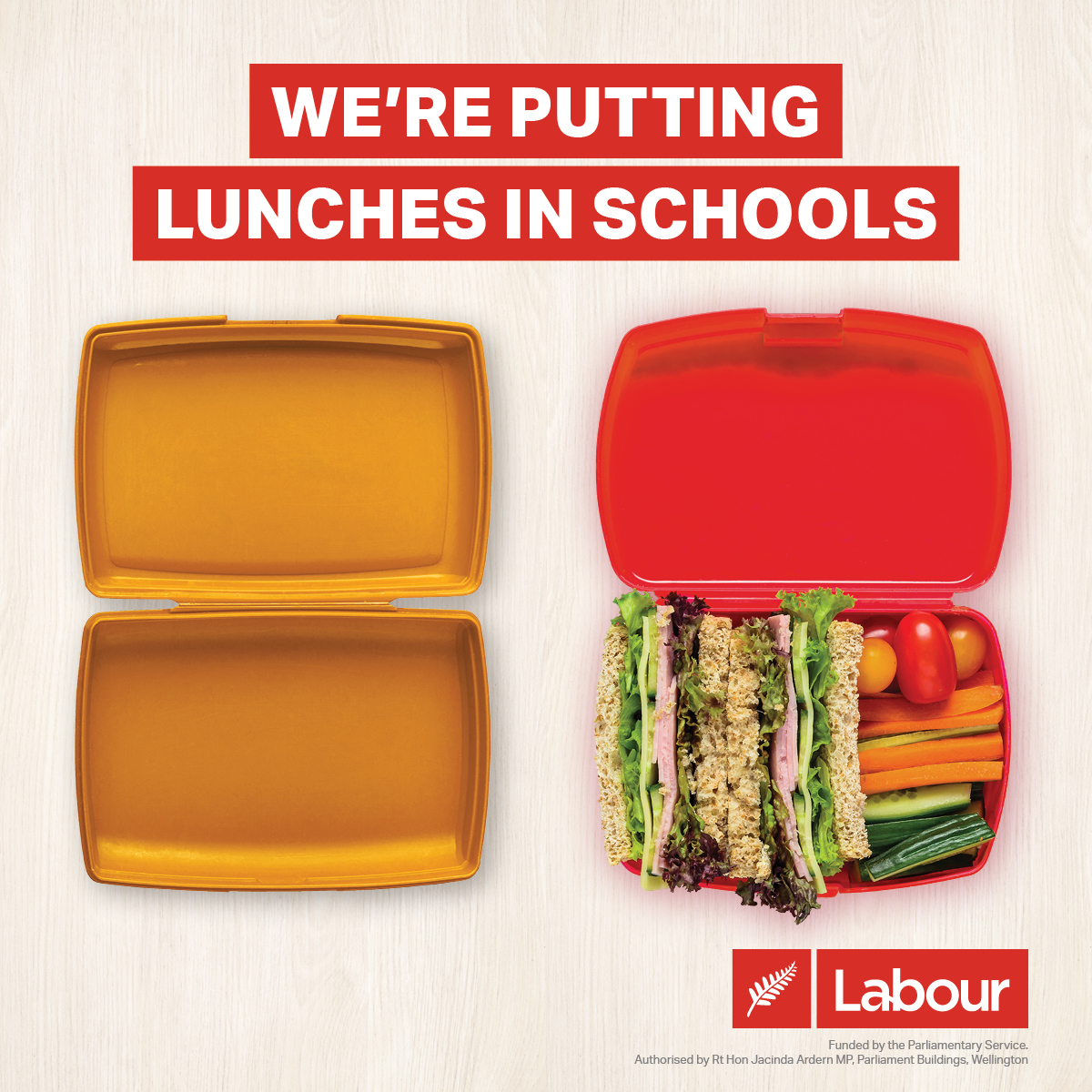
Speaking of which, our school is one of the lucky ones benefiting from the Free Lunches In Schools programme.  It happened very quickly - the budget was announced then exactly one week later - poof!  The lunch programme is on.  What is fantastic about it is that it doesn't single those in need out.  The food is available for everyone.  While we did have Kidscan lunches available at our school prior to this, the way these were dispersed was tricky.  The teachers had to make a sneaky informed guess at who was missing out that day, then send a message to reception who would ensure they had a lunch.  And while Kidscan is an amazing charity that I wholeheartedly support, it is limited.  It can't afford to feed everyone.  Those with the paperbag Kidscan lunches were more obvious.

As a kid who grew up with less I know how tough that is.  I went to a small, high decile school - you could count the poor kids on one hand - we stood out.  And as a kid that was different in other ways it was just another thing that made me feel left out.  The great thing about the free lunch plan is it removes the need for othering.  All the kids are allowed to say yes to some free lunch.  Our kids go to school with ample lunches they pack themselves and they've said yes to parts of the school lunch.  Etta tried peaches the other day.  She would never try them at home, but her friends were having them.  Not only does this plan fill empty tummies and helps everyone do better in the classroom, but it builds a sense of community.  Like the whakatauki in Abby's classroom says - 'He waka eke noa.' - we are all in this together.

Anyhow, on to what we ate yesterday.

The cheapest meat I could find.


Yesterday was the one day I bought meat for.  And the only reason I could buy meat was because I found this bargain at Pak 'n' Save a week ago and popped it into the freezer.  The only thing I could have got cheaper that was actual meat, was chicken bones.  Since the rise of MKR, even offal is dearer than this.

And I am so glad that I did.  After just two days eating on limited funds, we were both hungry.  Murray felt dizzy on the way home from work and I was grumpy and hungrier than usual and very excited about the prospect of dinner.  The thing that high protein foods do is keep you full for longer.  While carbs are a good stopgap, they are not a great long term fix.  If you want energy to last through the day you need to eat decent protein (which is why many nutritionists recommend having protein based breakfasts when you are trying to lose/or maintain a healthy weight).  So with this chicken, egg fried rice and some peanuts we actually managed to make our recommended protein quota for the day - but having it at the end of the day meant we lost out on all that it could have given us earlier on.

Consequently, this was our biggest spend day.  We both ate more than planned WAY over the daily of $5.70, but with that pittance of food on Monday, we're still on track with budget for the week.  This does mean there is no wriggle room in what we eat over the next two days though, and that makes me feel a bit nervous.  How did we do in the other areas of nutrition? 

We managed to make our vege quota.  This is because I bought seasonally and on special - I got a massive cauliflower from Countdown for $2 and used 1/2 of it in dinner.  Brocolli is reasonably priced at the moment so we had 1/4 of this too.  This plus the mixed veges in the egg fried rice, plus the carrot and corn with our lunch means we had 3 - 4 servings of veg - but still only one serving of fruit.  We also dipped out in the whole grains and our dairy intake was basically negligible - I maybe had 1/4 of my daily dietary requirements so am thankful broccoli is also a good source of calcium.

                                                            Winner winner chicken dinner


So was the food delicious?  Yes!  I like egg fried rice and veges and ginger and chicken.  But did it meet our nutritional requirements?  No.  2/5 is not a passing mark.  And the type of meat you can afford on this budget isn't exactly the healthy kind.  We usually buy skinless chicken breast if I'm using chicken - a good, low fat, healthy protein.  A whole chicken leg with skin and fat and bone isn't exactly healthy, but if I'm hungry, there is no way I'm getting rid of any of it.

Tune in tomorrow to see how I coped with work and this challenge.  I have a funny story to tell you...

Wednesday, 27 May 2020

Live Below The Line: Day 2

Daily posting is going to be a challenge in itself!  So I will keep these posts brief.

Yesterday went more to plan than Monday.  So I can show you how we spent that days money.  We went a little over what was planned because Mum, bless her heart, decided to make naan bread and give us some.  Because we went so far under budget on Monday, I factored it in and we had a garlic naan entree which was very much welcomed by Murray who had his first day back in the actual physical office* yesterday since the start of lockdown.

This is what we ate yesterday:

Now before I go into the nutritional deficits I want to talk about costings.  I have costed this by the cost of the purchased ingredients, divided by the quantity used.  I googled every single item to check the weight by cup or equivalent measure to ensure this was accurate.  I purchased from where I usually do (Pak n Save and our local Asian grocer) and while I did swap for cheaper brands where possible, I did keep to our usual brands on a few things (mostly because our usual brands are cheap!)  The licorice tea is cheaper than it usually would be because I bought it a while ago at the Clearance shop for cheap.  The black tea is Homebrand - also very cheap.  We opted for the cheapest fruits and veg - which are, incidentally, what is currently in season.  I honestly tried to get as much bang for our buck as we could without changing much about where and how we usually shop.

So lets look at what adults are supposed to eat every day and see how today's eating stacks up:

Two servings of fruit and three servings of vegetables
At least six servings of grains
At least two servings of dairy or dairy equivalents
At least two servings of legumes OR one serving of seafood, eggs, poultry or meat.

 Abby's mandarin tree.  We have seven fruit
trees, all fruiting age (three first fruiting this year)
The ability to plant and own fruit trees is a privilege.


The obvious outlier is we are missing a fruit serving.  And while we could have had another kiwifruit instead of the naan, you must remember that this was extra.  We were being polite to my Mum, and this was not planned for.  I worked really hard on this budget, and while there was wriggle room for another piece of fruit on some days, there was not room every day.  If we could eat the fruit that we get for free from our neighbours, or our own trees, we could have made up that deficit.  But the fact we have fruit trees, and friends with fruit trees is a privilege.  So for this week, like those without these privileges, we make do with less.  We DID have enough servings of vegetables.  This is mostly because we had left over salad from a family BBQ on Sunday which we did not want to waste so costed it out and had it with dinner.  The salad, plus the corn in the fritters, plus the carrot snack and in the soup makes our vege tally about four.  So that's good news.

Last nights dinner - filling and tasty, although the salad was weird
(2 leftover salads mixed together)


In the grains department we make it to about five servings if we count the Anzac biscuit and popcorn together as a serving.  We had rice with our soup.  The problem is, ALL the grains in todays diet were not whole.  All were the cheap options - white rice, white flour etc.  So nutritionally, it doesn't quite hit the mark.  Dairy is very much lacking.  I'd stretch and say we each had about one serving with the feta in the salad, the yoghurt in the naan bread and the milk in our breakfast and coffee put together.  The protein is also a miss.  We did have one serving of legumes with the soup for lunch and had about 1/4 of an egg in the corn fritters (as they serve 4 meals), and a few walnuts in the salad but that's it.

And I was trying!  I was really trying to create filling, balanced, healthy meals.  And while it certainly wasn't the worst diet a person could have, it still missed the mark.  The amount of money is just not enough to buy those expensive things - the dairy, the simple proteins, the fruit.  So did I go hungry yesterday?  No I did not.  Was all my food awful?  No it wasn't.  But my nutritional needs were not met.  This is why the kids are not doing this challenge.  While they could easily subsist on a diet of tomato soup, plain pasta, white bread and noodles and come under budget, they shouldn't.  They are growing.  They are learning.  They are kids.  But many kids do.  And it isn't about parenting, it's about a simple lack of funds and trying to keep those tummies full.  Simple carbs achieve that.

Tune in tomorrow where I will show off the only meal with meat for the week and sing the praises of the new Lunches In Schools programme.

* He slipped up and had a coffee at work which has a fancy pod machine, so I had to factor that in.  An expensive slip at 50c a coffee!  Hoping it doesn't happen again today as we don't have much more wriggle in our budget.

Tuesday, 26 May 2020

Living Below The Line - Day one

So this is awful timing for this challenge, but also, a really good time to do a challenge that illustrates what it is like for many Kiwis right now.  Coming out of lockdown with all the uncertainty of living in this post-Covid world I think it's important that everyone learns to live with less.  Because there but for the grace of God go I.  Right now, we are financially ok.  But had we worked in different industries, this would not have been the case.  For those of us who are ok, we should have a little empathy, and give our strength and support to those who are not.

I don't expect sponsorship.  I know times are tough for many which is exactly why I am doing this.  If you can afford to, and you want to just click on the link here and nominate any amount.  Otherwise, if reading this makes you feel bad, just check in on your neighbours and whanau.  Make sure they're doing ok.

My desire to write today specifically is spurred by the governments latest payment scheme.

Their plan to increase benefits for those who lose their jobs due to Covid may seem nice on the surface.  But the reality is that it shelters those who do from the reality of living on a benefit in New Zealand.  From the reality of tracking the amount you, or your partner earns to ensure it doesn't inversely affect your income.  From the reality of being hungry, of having to plan everything, of having no flexibility, little choice, in your daily life.  Creating this difference - between pre-Covid and post-Covid beneficiaries enforces the ideology somehow these job losses are different.

I know you are a good person Carmel.  Surely you can see how wrong this is.


And it allows the government to continue paying an unlivable benefit.  It allows those whose recent misfortune is now buffered to say things like 'Well, I lost my job and I'm still managing!'  It allows this division of thinking to continue.  My mother worked hard her whole life until her health no longer allowed her to.  Like thousands of other New Zealanders.  And our previous government got rid of the Sickness Benefit.  So, those who have been less fortunate in the health department, like my Mum receive 'Jobseekers support'.  The same as their able bodied peers.  This means that they all have to get signed off by Drs regularly.  Even if they have chronic conditions they must provide paperwork to WINZ otherwise their benefit will be cut off.  This is the case for those going through chemo, those with disabilities, those with chronic illness, those with mental illness.

What this payment says is that these people, who have also ended up in the system through no fault of their own, are worth less than those who recently lost their jobs.  That everyone else who may have lost their jobs, every other person who, through circumstance, was on a benefit before Covid-19, is worth less.  Even though they have managed to survive on a pittance for, in some cases, decades, they still do not deserve a livable income but somehow the recently impoverished do.  This truly sickens me.

Anyhow, I digress.  Now, to the challenge.

Today, and tomorrows, morning coffee.  Farewell Avalanche.


Murray is doing it with me to make cooking simpler (I am pleasantly surprised).  We have to subsist on $2.85 each per day for food for five days.  Now, I know many folk who live well below this.  I know people who've had to live with less than $10 to feed themselves.  But in the context of the rest of New Zealand, an average family of 2 adults and two children spend about $290 per week on food.  This amount is just over 1/4 of that amount.  What I'm hoping to illustrate over this week though is the extra work involved in managing living on so much less.  The amount of time I have to put into managing our budget.  The lack of choice.

Lentil and carrot is the soup of the next two days

I also need to say that I come to this challenge with a lot of privilege.  I did accounting right through school (a positive side effect of growing up poor), so I can budget well.  I have worked in the food industry and have an interest in nutrition, so cooking for health is not difficult for me.  I have more time than many.  Yes I have kids and work 26 hours per week, but that is less than many, especially our working poor.  I also live close to civilization and have access to reliable transport, childcare and internet.  And when this is over I know I can order from my favourite local Indian restaurant.  All of this privilege means that my window into this week is rose tinted.  This is not a picture of the reality for those living in poverty.

Because of this privilege I planned and budgeted this week in advance leaving room (money) aside for alterations.  I am so glad I did this because on the first day I was horribly ill.  This meant I had no interest in cooking, or eating, the food I had planned.  And while this did save some money, it did mean that the nutrition in my diet yesterday was non-existent.  This is what me and Murray ate yesterday.  It's pretty empty.

Were I sick under normal circumstances, I would have filled it differently.  I would have had lemonade, or gingerale.  But on this budget, this wasn't possible.  Murray's epilepsy means he can no longer drive, and I was not well enough to go far.  So this would have to come from a dairy, and would cost at least $1.50 - $4.00.  This was not  a cost I could justify given the amount we have for this week.  Equally, after my visit to A&E (only possible because we aren't in poverty, otherwise it'd have had to be Waitakere Hospital) I might have bought some fries from McDonalds.  At the exorbitant price that they are for something nutritionally negligent and small, this also was not justifiable.

Compare what we ate yesterday with what we are supposed to eat in a healthy diet.
In a healthy diet, this is what an adult should be eating daily:

Two servings of fruit and three servings of vegetables
At least six servings of grains
At least two servings of dairy or dairy equivalents
At least two servings of legumes OR one serving of seafood, eggs, poultry or meat.

While Monday's food is not fairly representative of what we had planned, I can tell you there is no way you can meet these nutritional needs on a poverty budget.

Just from planning our meals I can see how very easy it would be to just opt for high carb, high calorie, filling foods.  They are cheaper and easier to prepare.  Using the same budget I could just eat toast for breakfast, 2 minute noodles for lunch and a pie and oven chips for dinner.  And I'd have a little left over for crisps or biscuits or maybe some cheap fruit.

Anyhow.  I need to save some of this vitriol for later.  Tune in tomorrow to see a proper days eating and watch me break it down nutritionally to show you the deficits. 

Tuesday, 28 May 2019

Failing the Challenge

Failure is an awful feeling.

Especially when it's a choice.

Because I did have a choice.  I could have held on and mucked through.  But the truth is that aside from the challenge last week was unpredictably tough.

A new recipe I made for the challenge -
Scottish oatcakes.  Quite tasty!  And cheap!


First off, the challenge was tougher than I thought it would be!  While it was different from the Ration Challenge in that I didn't feel that hard, aching hunger (I did make it halfway through the challenge), I did feel hungry at times.  I was much more anxious than usual as I knew how reliant I was on prep, and had to remember to bring the food I'd prepped with me to work.  My time felt much more precious.  And I had less of it than I had during last years challenge.  Even though I had more 'choice' in food than last time, it was still tough to eat the same thing for days in a row.  And even though those things were things I'd chosen that I like, the lack of variety was tough.

And then I got the headaches.  On the second day of the challenge I felt super wiped out and had a massive headache.  After school drop off, on the only day I have home alone, when I'm usually cleaning or writing, I went to bed to read and passed out for three hours.  The next day felt much the same, and not helped by a 5am start (Abby likes to wake up around then).  While I was hoping to have some time to rest and do food prep, after grocery shopping I had to pick Abby up from Kindy as she had a reaction to her immunisations which put everything - food, rest and work, into a spin.

My usual morning coffee           

When I saw my Mum before heading into work she told me the headaches were probably caffeine
withdrawal.  It seemed weird as I only have one coffee most mornings, and never had this when I did The Ration Challenge.  But the timing made sense.  I popped some paracetamol and headed into work.  Work was insane.  I'd forgotten we had a nursery sale on, which is always the busiest sale of all.  I worked extra hours to help out.  I was so busy, the headaches became some low background haze.

When I arrived home on Friday, I learned a dear friend had passed away on Thursday night.  It was expected, but still, grief hit me like a tidal wave.  And I had no food prepped.  After that, I just didn't have the resolve to continue.  All my resolve just left my body.

Had I been in the position of someone actually living below the line, I could not have done the things I did next.  I could not have afforded the petrol, or bus-fare to head North to say goodbye.

Even though I didn't finish the challenge, my circumstances really hit home to me how hard it would be to be in a less privileged position.

Had I been in the position of someone living below the line, there would be no way I could have gone to say goodbye.  We had to pay for the petrol to drive up to her Marae.  We had to find easy ways to feed the kids.  I needed to give her whanau a koha to help with the tangi.  She was loved by so many, it is no small thing.  And we are fortunate in that we can do that.  Not everyone can.  Even when they love someone with all their heart, not everyone has the option to drop everything to farewell their loved ones.

This privilege was reiterated when on driving home I got another headache.  This one put holes and rainbows through the left side of my vision.  This has happened to me before, and it was due to a severe sinus infection.  I then realised my earlier headaches probably weren't caffeine withdrawal*, but the beginning of this infection.  We drove straight from Northland to our local White Cross so I could get a check up and some meds.  Two more things that may not have been possible had I not been in the position to afford the emergency Drs fee, or the medication.

I do not regret opting out.  I needed to farewell my friend but I am so, so grateful that I am in the position that I could.

I know there is more to say, but right now I feel tired, hurt and raw.  So I will revisit this in the future.  In the meantime, I will take nothing for granted.


* Just in case, I've quit coffee anyway.  It had just become a habit after I had kids.  I never used to drink it.  To my knowledge, I've never experienced withdrawal symptoms from anything.  After hearing how bad they are, I have no desire to.

Monday, 20 May 2019

Prep for Living Below The Line

So I am starting this challenge tomorrow.

I just finished the last of my shopping (veges) and am feeling pretty good going in to this.  Certainly, compared to the Ration Challenge, this feels easier.


Last years Ration Challenge gave me this plus salt, lemon pepper, cinnamon, 125g of tofu, 170grams of carrots and 120 grams of peanuts.

This year, my $19.95 has bought me all this plus I have $2.03 left over to spend on small, cost calculated, extras from the pantry*.  I opted to just shop at my usual places that are easily accessible by foot, rather than going to the bulk foods store which is a bit further.  Shopping around is  something not always easy for someone on limited means.  All of this comes from Pak n Save Alderman Drive and our local Asian vege store - besides the pumpkin which was an impulse buy from Countdown when doing a fruit dash for kids lunches as it was just $2!


I feel like for me, this is plenty.  My $19.95 bought me 500g of rice, 6 eggs, 500g yellow split peas, 750g oats, a tin of creamed corn, tomatoes and coconut cream, a large pumpkin, about 1/2 a cup of roasted, salted peanuts, some popcorn kernels, 2 mushrooms, 2 lemons, some onions, a bag of carrots and a little bit of ginger and garlic.  It is definitely enough to make enough meals for me to live on.  And it wasn't all planned!  Although I am very much a planning down to the last cent kind of person, the pumpkin was so big and cheap I couldn't walk past it and I kinda splurged on mushrooms and lemons.  So I don't feel hard done by.

But there are some notable things missing.  Meat is expensive, and something that I lived without for years, so it was a no-brainer to not even bother.  Also, no dairy.  I had hoped I'd be able to afford some cheese, but the sacrifices I'd have had to have made for that cheese was not worth it.  Nor is there bread.  I could definitely not afford the gluten free bread I usually buy, nor is it worth it for me to buy $1 bread even though it would make this coming week easier**.  I really wanted to buy a bag of fruit, but when it came down to a choice between carrots and fruit, I went with carrots because they were cheaper, and also more flexible.  There are no quick meals here - besides porridge, carrots and eggs.  All my main meals take time and preparation.

Vege shopping (sans pumpkin)

There are no drink things here.  Even though I do drink coffee every morning, it hadn't crossed my mind until after I'd done my supermarket shop.  Not that I could afford it without cutting into other things.  And even then, it would have to be the cheapest instant coffee and I'd have to have it without milk, which is yuck.  And spend more on pantry sugar.  All round, it was not possible.  This week's 'coffee' will be lemon in hot water.  That way I still feel like I'm having 'something', while also having some vitamin C.

Because while this week is more vegeful than my Ration Challenge week, it still doesn't meet the nutritional minimum.  I've worked out I'll get about 3 or 4 out of my 5 plus a day from this.  So while it's ok, it's not ideal.  Looking at this picture, I have no idea where my calcium will be coming from, and I'm guessing there will be other things I've missed out on nutritionally given I'm not a trained nutritionist.

Tarka daal, YUM! (and cheap to make)      

 But I am excited about the meals!  I decided to base my food choices around healthy(ish) comfort foods that I usually eat.  So I'm making my favourite Taarka Daal, pumpkin soup, sweetcorn fritters and egg fried rice, in quantities that will give me multiple meals.  I will supplement this with 'found' salads, oat-flour flatbreads, carrot sticks and peanuts.

To make this experience more 'true' to living below the line, I will also not exercise any personal spending.  It feels silly to restrict one side of life, and not any other.  So no retail therapy, no Instant Kiwis (secret bad treat) and only free-to-air TV this week.

While I am not asking for donations directly, if you appreciate what I'm doing here, feel free to donate to Live Below the Line, the Ration Challenge ***, KidsCan or Foodbank New Zealand.

Watch this space for updates!


* Limited, cheap spices cost 10c per teaspoon, salt costs 1c per teaspoon, soy sauce costs 6c per Tbsp, canola oil costs 6c per Tbsp, brown sugar costs 25c for 1/4 cup, white flour costs 15c for 1 cup, baking powder costs 7c per tsp.  I'm not intending on using much of any of these.

** The only naughty for my health thing I bought was the onion, but that quantity spread over a week should not cause a drama.

*** If you don't know anyone doing the challenge, you can still donate!  What I did last year was topped up a few teams or individuals who were at the bottom of the leaderboards to help them feel more supported.  Great way to boost someone doing something super tough whilst giving to a great cause.


Wednesday, 15 May 2019

Why Food Challenges are important... to me anyway.

It's weird being middle class.  Having grown up very not middle class, it's confronting*.  It's a daily battle amalgamating two different sets of values.  And this reiterates to me just how much our childhood impacts us.  From the foods we like to eat, to the people we socialise with to the jobs we choose and the aspirations we have.  My childhood defines me, for both better and worse.
Growing up I never thought I would own my own home.

Living in relative comfort, I feel a sense of guilt every day.  I know what I have.  Poverty is not theoretical to me.  Not only have I been in this position, but I still have family in this position.  My daughter goes to a decile 3 school, a KidsCan school.  We can see the need for that support in our community.  Conversely, we have enough food to fill our kids lunchboxes.  We have enough money to pay our mortgage - we own a house in Auckland.  We have Netflix.  I know these are the sorts of things many people we know may take for granted as basics.  But I also know they aren't.

At the moment I'm feeling especially guilty because The Ration Challenge is starting again soon and I'm not doing it.

This year is a bit of a struggle for me.  My workload is heavy, family stuff is heavy and my health is suffering.  The Ration Challenge is bloody tough!  I struggled to get through my normal workload last year.  And currently, I'm working more than I was last year so it just doesn't feel feasible**.  Last year I got the shakes.  I cried.  I lost 2kg that week.  And I wasn't even living on the minimum.  As one of the fortunate folk connected enough to get good sponsorship, I enjoyed a few extras.  I can't imagine how hard it would have been without them.

I know I'm making the right decision.  But I still feel guilty.  It's not even just about the money.  After last years challenge, facing the reality of what thousands of people live with on a daily basis, I started donating a small amount monthly to Oxfam.  I know that even a small amount makes a difference.  But giving money isn't enough to assuage my guilt.

     The Ration Challenge is bloody tough!

Doing this challenge last year was hard, but doing it felt really good.  Not only because I raised much more money than I ever thought I could, but because it reminded me of just how lucky I am.  It reminded me how easy it might be for someone in my position to forget.  And that if someone's never felt hungry for longer than a few days, it is difficult for them to understand the long term impact of hunger.  In fact, every person I've spoken to who works in fundraising has said that the areas where people give the most, often have the least.  Fundraisers do better in low income areas, like Henderson and Mangere, than in places like Remuera or Parnell.  I think it's because in wealthy areas many have no concept of what it's like to live with so little.

Of course, many people rise from poverty to relative financial success who have also forgotten.  The two people foremost in my mind are our former PM John Key, and National MP Paula Bennett.  They too lived through tough times.  Both were reliant on government support for a time - John Key as a child who's mother was on the Widows Benefit, and Paula Bennett via the DPB as a young Mum.  I'm not saying they didn't work hard to get to where they are now.  I've seen the video of John Key working the stock market, pissing into a bottle.  I'm just saying that other people work just as hard and don't move far from where they started.  I'm scared that if I forget where I came from, if I forget how it feels to have less choice, to be hungry, I could easily be like them.

The Cycle of Poverty                 
It doesn't always look like this         
but a good overview nonetheless.       

So while I am not doing the Ration Challenge, I've decided I will do a food challenge.  After last year, I think I'm going to have to do one every year to ensure I don't forget.  This year I've decided I'm going to do the Live Below The Line challenge for 7 days instead.  The last time I planned on doing this I had to flag it as I found out I was pregnant with Etta the week before I was due to start...  Now the time for this actual challenge has already passed this year.  But given my goals are (in a way) selfish, there is no reason why I can't just do it anyway.

I have chosen this challenge because, while it feels as though it'll be easier than the Ration Challenge, it is still going to be a challenge.  I will have $19.95 to feed myself for seven days.  The main difference between this and The Ration Challenge is that I have some choice.  The Ration Challenge was particularly hard due to the dire lack of vegetables.  While the perks in the Ration Challenge did drive me to fundraise more, it simultaneously added to the stress of doing the challenge.  I know people who live on this amount, or a little less, or a little more, most weeks.  It is important that I remind myself of how it feels to be like them.  The flow on effect of having limited options.  And I can write about my experience and hope it gives an insight as to why it's so important to have compassion for those with limited means.

I also understand that donating money is a privilege.  Many want to give, but truly cannot.  Last year I felt as if a few of my friends and whanau felt bad about not donating, or not donating more.  I don't like making people feel bad.  So I'm not going to ask for donations on social media.  I will post some links in my blogs in case people want to donate independently, and will also provide links later on for places you can donate food or time to help those in need.

The wonderful, prolific vege, puha

Doing this off book means I'm allowing myself a couple of perks.  The perks are things we can all do to supplement our diet here in NZ, but were not possible in the Ration Challenge***.  Because I'm an experienced forager, and know many in poverty are not, I'm only going to forage basic foods found in most places around NZ - dandelion, puha, nasturtium, rosemary and wild fennel.  Equally, I've opted to spend a little of my $19.95 on pantry basics that will last six+ weeks, to trade (by value amount) for pantry basics I could conceivably have bought during previous weeks if this was my normal budget.  I've chosen salt, pepper, turmeric, garam masala, soy sauce and small amounts of flour and white sugar.

And because I don't want this to impact my family as much as The Ration Challenge did last year, I am doing it at a time that works best for us.  So my Challenge week will be the 21st to the 27th of May (after Etta's birthday celebrations are finished).  Last year the last night of the Ration Challenge fell on our annual Matariki celebration - which is literally a feast with old friends.  That was hard!  I'm also not taking on as many additional hours at work that week (this was hard in that I suck at saying no).  I know that doing this demonstrates my privilege, but I am making some allowances for my health this year.

Refugee camps in Jordan.  It's no small thing.


If you are in good health and want to understand what it's like to live with less, I highly recommend participating in The Ration Challenge.  It is tough, but it gives the gift of insight into how whole communities survive on so little.  It forces us to form communities, and support strangers.  The lessons I learned from doing this year are invaluable.  I cannot emphasise this enough.  And I promise I will sponsor you.

* Talk about First World Problems...

** In fact, Murray told me he was very glad I wasn't doing it again as last year was also tough on him and the kids...

*** Because it was emulating the situation for refugees in camps in Jordan, which are basically settled on dust.