Showing posts with label poverty in NZ. Show all posts

Tuesday, 28 May 2019

Failing the Challenge

Failure is an awful feeling.

Especially when it's a choice.

Because I did have a choice.  I could have held on and mucked through.  But the truth is that aside from the challenge last week was unpredictably tough.

A new recipe I made for the challenge -
Scottish oatcakes.  Quite tasty!  And cheap!


First off, the challenge was tougher than I thought it would be!  While it was different from the Ration Challenge in that I didn't feel that hard, aching hunger (I did make it halfway through the challenge), I did feel hungry at times.  I was much more anxious than usual as I knew how reliant I was on prep, and had to remember to bring the food I'd prepped with me to work.  My time felt much more precious.  And I had less of it than I had during last years challenge.  Even though I had more 'choice' in food than last time, it was still tough to eat the same thing for days in a row.  And even though those things were things I'd chosen that I like, the lack of variety was tough.

And then I got the headaches.  On the second day of the challenge I felt super wiped out and had a massive headache.  After school drop off, on the only day I have home alone, when I'm usually cleaning or writing, I went to bed to read and passed out for three hours.  The next day felt much the same, and not helped by a 5am start (Abby likes to wake up around then).  While I was hoping to have some time to rest and do food prep, after grocery shopping I had to pick Abby up from Kindy as she had a reaction to her immunisations which put everything - food, rest and work, into a spin.

My usual morning coffee           

When I saw my Mum before heading into work she told me the headaches were probably caffeine
withdrawal.  It seemed weird as I only have one coffee most mornings, and never had this when I did The Ration Challenge.  But the timing made sense.  I popped some paracetamol and headed into work.  Work was insane.  I'd forgotten we had a nursery sale on, which is always the busiest sale of all.  I worked extra hours to help out.  I was so busy, the headaches became some low background haze.

When I arrived home on Friday, I learned a dear friend had passed away on Thursday night.  It was expected, but still, grief hit me like a tidal wave.  And I had no food prepped.  After that, I just didn't have the resolve to continue.  All my resolve just left my body.

Had I been in the position of someone actually living below the line, I could not have done the things I did next.  I could not have afforded the petrol, or bus-fare to head North to say goodbye.

Even though I didn't finish the challenge, my circumstances really hit home to me how hard it would be to be in a less privileged position.

Had I been in the position of someone living below the line, there would be no way I could have gone to say goodbye.  We had to pay for the petrol to drive up to her Marae.  We had to find easy ways to feed the kids.  I needed to give her whanau a koha to help with the tangi.  She was loved by so many, it is no small thing.  And we are fortunate in that we can do that.  Not everyone can.  Even when they love someone with all their heart, not everyone has the option to drop everything to farewell their loved ones.

This privilege was reiterated when on driving home I got another headache.  This one put holes and rainbows through the left side of my vision.  This has happened to me before, and it was due to a severe sinus infection.  I then realised my earlier headaches probably weren't caffeine withdrawal*, but the beginning of this infection.  We drove straight from Northland to our local White Cross so I could get a check up and some meds.  Two more things that may not have been possible had I not been in the position to afford the emergency Drs fee, or the medication.

I do not regret opting out.  I needed to farewell my friend but I am so, so grateful that I am in the position that I could.

I know there is more to say, but right now I feel tired, hurt and raw.  So I will revisit this in the future.  In the meantime, I will take nothing for granted.


* Just in case, I've quit coffee anyway.  It had just become a habit after I had kids.  I never used to drink it.  To my knowledge, I've never experienced withdrawal symptoms from anything.  After hearing how bad they are, I have no desire to.

Monday, 20 May 2019

Prep for Living Below The Line

So I am starting this challenge tomorrow.

I just finished the last of my shopping (veges) and am feeling pretty good going in to this.  Certainly, compared to the Ration Challenge, this feels easier.


Last years Ration Challenge gave me this plus salt, lemon pepper, cinnamon, 125g of tofu, 170grams of carrots and 120 grams of peanuts.

This year, my $19.95 has bought me all this plus I have $2.03 left over to spend on small, cost calculated, extras from the pantry*.  I opted to just shop at my usual places that are easily accessible by foot, rather than going to the bulk foods store which is a bit further.  Shopping around is  something not always easy for someone on limited means.  All of this comes from Pak n Save Alderman Drive and our local Asian vege store - besides the pumpkin which was an impulse buy from Countdown when doing a fruit dash for kids lunches as it was just $2!


I feel like for me, this is plenty.  My $19.95 bought me 500g of rice, 6 eggs, 500g yellow split peas, 750g oats, a tin of creamed corn, tomatoes and coconut cream, a large pumpkin, about 1/2 a cup of roasted, salted peanuts, some popcorn kernels, 2 mushrooms, 2 lemons, some onions, a bag of carrots and a little bit of ginger and garlic.  It is definitely enough to make enough meals for me to live on.  And it wasn't all planned!  Although I am very much a planning down to the last cent kind of person, the pumpkin was so big and cheap I couldn't walk past it and I kinda splurged on mushrooms and lemons.  So I don't feel hard done by.

But there are some notable things missing.  Meat is expensive, and something that I lived without for years, so it was a no-brainer to not even bother.  Also, no dairy.  I had hoped I'd be able to afford some cheese, but the sacrifices I'd have had to have made for that cheese was not worth it.  Nor is there bread.  I could definitely not afford the gluten free bread I usually buy, nor is it worth it for me to buy $1 bread even though it would make this coming week easier**.  I really wanted to buy a bag of fruit, but when it came down to a choice between carrots and fruit, I went with carrots because they were cheaper, and also more flexible.  There are no quick meals here - besides porridge, carrots and eggs.  All my main meals take time and preparation.

Vege shopping (sans pumpkin)

There are no drink things here.  Even though I do drink coffee every morning, it hadn't crossed my mind until after I'd done my supermarket shop.  Not that I could afford it without cutting into other things.  And even then, it would have to be the cheapest instant coffee and I'd have to have it without milk, which is yuck.  And spend more on pantry sugar.  All round, it was not possible.  This week's 'coffee' will be lemon in hot water.  That way I still feel like I'm having 'something', while also having some vitamin C.

Because while this week is more vegeful than my Ration Challenge week, it still doesn't meet the nutritional minimum.  I've worked out I'll get about 3 or 4 out of my 5 plus a day from this.  So while it's ok, it's not ideal.  Looking at this picture, I have no idea where my calcium will be coming from, and I'm guessing there will be other things I've missed out on nutritionally given I'm not a trained nutritionist.

Tarka daal, YUM! (and cheap to make)      

 But I am excited about the meals!  I decided to base my food choices around healthy(ish) comfort foods that I usually eat.  So I'm making my favourite Taarka Daal, pumpkin soup, sweetcorn fritters and egg fried rice, in quantities that will give me multiple meals.  I will supplement this with 'found' salads, oat-flour flatbreads, carrot sticks and peanuts.

To make this experience more 'true' to living below the line, I will also not exercise any personal spending.  It feels silly to restrict one side of life, and not any other.  So no retail therapy, no Instant Kiwis (secret bad treat) and only free-to-air TV this week.

While I am not asking for donations directly, if you appreciate what I'm doing here, feel free to donate to Live Below the Line, the Ration Challenge ***, KidsCan or Foodbank New Zealand.

Watch this space for updates!


* Limited, cheap spices cost 10c per teaspoon, salt costs 1c per teaspoon, soy sauce costs 6c per Tbsp, canola oil costs 6c per Tbsp, brown sugar costs 25c for 1/4 cup, white flour costs 15c for 1 cup, baking powder costs 7c per tsp.  I'm not intending on using much of any of these.

** The only naughty for my health thing I bought was the onion, but that quantity spread over a week should not cause a drama.

*** If you don't know anyone doing the challenge, you can still donate!  What I did last year was topped up a few teams or individuals who were at the bottom of the leaderboards to help them feel more supported.  Great way to boost someone doing something super tough whilst giving to a great cause.


Wednesday, 15 May 2019

Why Food Challenges are important... to me anyway.

It's weird being middle class.  Having grown up very not middle class, it's confronting*.  It's a daily battle amalgamating two different sets of values.  And this reiterates to me just how much our childhood impacts us.  From the foods we like to eat, to the people we socialise with to the jobs we choose and the aspirations we have.  My childhood defines me, for both better and worse.
Growing up I never thought I would own my own home.

Living in relative comfort, I feel a sense of guilt every day.  I know what I have.  Poverty is not theoretical to me.  Not only have I been in this position, but I still have family in this position.  My daughter goes to a decile 3 school, a KidsCan school.  We can see the need for that support in our community.  Conversely, we have enough food to fill our kids lunchboxes.  We have enough money to pay our mortgage - we own a house in Auckland.  We have Netflix.  I know these are the sorts of things many people we know may take for granted as basics.  But I also know they aren't.

At the moment I'm feeling especially guilty because The Ration Challenge is starting again soon and I'm not doing it.

This year is a bit of a struggle for me.  My workload is heavy, family stuff is heavy and my health is suffering.  The Ration Challenge is bloody tough!  I struggled to get through my normal workload last year.  And currently, I'm working more than I was last year so it just doesn't feel feasible**.  Last year I got the shakes.  I cried.  I lost 2kg that week.  And I wasn't even living on the minimum.  As one of the fortunate folk connected enough to get good sponsorship, I enjoyed a few extras.  I can't imagine how hard it would have been without them.

I know I'm making the right decision.  But I still feel guilty.  It's not even just about the money.  After last years challenge, facing the reality of what thousands of people live with on a daily basis, I started donating a small amount monthly to Oxfam.  I know that even a small amount makes a difference.  But giving money isn't enough to assuage my guilt.

     The Ration Challenge is bloody tough!

Doing this challenge last year was hard, but doing it felt really good.  Not only because I raised much more money than I ever thought I could, but because it reminded me of just how lucky I am.  It reminded me how easy it might be for someone in my position to forget.  And that if someone's never felt hungry for longer than a few days, it is difficult for them to understand the long term impact of hunger.  In fact, every person I've spoken to who works in fundraising has said that the areas where people give the most, often have the least.  Fundraisers do better in low income areas, like Henderson and Mangere, than in places like Remuera or Parnell.  I think it's because in wealthy areas many have no concept of what it's like to live with so little.

Of course, many people rise from poverty to relative financial success who have also forgotten.  The two people foremost in my mind are our former PM John Key, and National MP Paula Bennett.  They too lived through tough times.  Both were reliant on government support for a time - John Key as a child who's mother was on the Widows Benefit, and Paula Bennett via the DPB as a young Mum.  I'm not saying they didn't work hard to get to where they are now.  I've seen the video of John Key working the stock market, pissing into a bottle.  I'm just saying that other people work just as hard and don't move far from where they started.  I'm scared that if I forget where I came from, if I forget how it feels to have less choice, to be hungry, I could easily be like them.

The Cycle of Poverty                 
It doesn't always look like this         
but a good overview nonetheless.       

So while I am not doing the Ration Challenge, I've decided I will do a food challenge.  After last year, I think I'm going to have to do one every year to ensure I don't forget.  This year I've decided I'm going to do the Live Below The Line challenge for 7 days instead.  The last time I planned on doing this I had to flag it as I found out I was pregnant with Etta the week before I was due to start...  Now the time for this actual challenge has already passed this year.  But given my goals are (in a way) selfish, there is no reason why I can't just do it anyway.

I have chosen this challenge because, while it feels as though it'll be easier than the Ration Challenge, it is still going to be a challenge.  I will have $19.95 to feed myself for seven days.  The main difference between this and The Ration Challenge is that I have some choice.  The Ration Challenge was particularly hard due to the dire lack of vegetables.  While the perks in the Ration Challenge did drive me to fundraise more, it simultaneously added to the stress of doing the challenge.  I know people who live on this amount, or a little less, or a little more, most weeks.  It is important that I remind myself of how it feels to be like them.  The flow on effect of having limited options.  And I can write about my experience and hope it gives an insight as to why it's so important to have compassion for those with limited means.

I also understand that donating money is a privilege.  Many want to give, but truly cannot.  Last year I felt as if a few of my friends and whanau felt bad about not donating, or not donating more.  I don't like making people feel bad.  So I'm not going to ask for donations on social media.  I will post some links in my blogs in case people want to donate independently, and will also provide links later on for places you can donate food or time to help those in need.

The wonderful, prolific vege, puha

Doing this off book means I'm allowing myself a couple of perks.  The perks are things we can all do to supplement our diet here in NZ, but were not possible in the Ration Challenge***.  Because I'm an experienced forager, and know many in poverty are not, I'm only going to forage basic foods found in most places around NZ - dandelion, puha, nasturtium, rosemary and wild fennel.  Equally, I've opted to spend a little of my $19.95 on pantry basics that will last six+ weeks, to trade (by value amount) for pantry basics I could conceivably have bought during previous weeks if this was my normal budget.  I've chosen salt, pepper, turmeric, garam masala, soy sauce and small amounts of flour and white sugar.

And because I don't want this to impact my family as much as The Ration Challenge did last year, I am doing it at a time that works best for us.  So my Challenge week will be the 21st to the 27th of May (after Etta's birthday celebrations are finished).  Last year the last night of the Ration Challenge fell on our annual Matariki celebration - which is literally a feast with old friends.  That was hard!  I'm also not taking on as many additional hours at work that week (this was hard in that I suck at saying no).  I know that doing this demonstrates my privilege, but I am making some allowances for my health this year.

Refugee camps in Jordan.  It's no small thing.


If you are in good health and want to understand what it's like to live with less, I highly recommend participating in The Ration Challenge.  It is tough, but it gives the gift of insight into how whole communities survive on so little.  It forces us to form communities, and support strangers.  The lessons I learned from doing this year are invaluable.  I cannot emphasise this enough.  And I promise I will sponsor you.

* Talk about First World Problems...

** In fact, Murray told me he was very glad I wasn't doing it again as last year was also tough on him and the kids...

*** Because it was emulating the situation for refugees in camps in Jordan, which are basically settled on dust.

Sunday, 4 March 2018

Bah Humbug to the Census

I've (clearly) had trouble blogging over the last month.

This is in part due to my new annual project, which involves writing one short story a month.  Sounds simple - but given that up until January I'd only written one short story since maybe 1996, it's a good challenge for me but it does use up my time and energy.

But I digress.

The main reason I've struggled to blog is that I've been too angry to blog.  The post that sits half finished in my draft pile is about racism in New Zealand.  I wanted to post it in a timely fashion to all the recent shitty events that occurred earlier in the year but it just wasn't possible.  Because I was too angry to post something heartfelt and rational that would be a good idea to put on the internet.

And I'm still angry.  About racism still, but about something else too.  The census.  And on this issue my ideas are simple and communicable.  So you get a post!

I usually get excited about the census.
This year it just made me sad and angry.

The census is carried out every five years and the reason we have a census is because (from the website):  

'Information from the census helps determine how billions of dollars of government funding is spent across New Zealand.  Because the information we collect is about everyone in New Zealand, it can be used to inform decisions and make plans about services and where they should be, such as hospitals, kōhanga reo, schools, roads, and public transport.'

So the census is quite an important thing to take part in.  Also, according to the Statistics Act of 1975 we have a legal obligation to complete our census forms.

And honestly, that's ok with me.  We need to know about the people who live here to get the right services to those who need them most.  And I understand that personal obligation comes into this equation.  But the level of obligation required for this years census seems unfair to the point I feel that it doesn't give all Kiwis an equal opportunity to be counted.

The Auckland Council has started using 'gender diverse' as an option for sex on its surveys.  Because I do a lot of surveys online, I have become quite accustomed to seeing 'gender diverse' as an option.  And while previous censuses have not had gender diverse as an option, I do not feel that is a good enough reason to continue ignoring that these people exist.  If the Auckland Council can change, why can't Statistics New Zealand change too?

Because while I don't personally identify as gender diverse* I know a number of wonderful folk that do.  So when I see a form that determines how billions of government dollars are spent, and that people I care about cannot even be accurately represented, I get pissed.  Because, yet again, they are:
a) rendered invisible and
b) forced to conform to an identity which is not their own 

And it's not as though they don't need representation.  Folk in LGBTQI communities need more support!  Bullying, suicide rates, mental illness, addiction, sexual abuse, having the shit kicked out of them by strangers - these are all issues that affect folk in our LGBTQI communities at much higher rates than in most other communities.  And yes, only a small subsection of this community will identify as 'gender diverse'.  Nevertheless, denying gender diverse or intersex folk the basic right of being represented accurately is just plain wrong.

As a comparison, for religion there is a text box option in  which you can fill with the appropriate faith system.  If they didn't want to include gender diverse as an option, why could they not have added 'other' with a text box like they did for religion?  The counter argument here is, of course, that in the 2001 census we managed to have the highest population per capita of Jedi (as a religion) in the world**  So it's easy to skew the census results - particularly in a small country like New Zealand.  Even so, religion still has a text box option - but sex still does not.

As it is, I found in the Q&A section of the census: My sex is not male or female.  How should I answer the sex question? The answer given is that you should call them on their 0800 number to discuss this.  Why would anyone, for whom their gender or gender identity may have made life difficult, want to call someone to discuss how to describe their gender?  This does not appear to be a well thought out solution.

And while friends have said please, request the paper form so you can voice your displeasure, I have heard that the forms are processed electronically.  So even if you do voice your displeasure on the paper form it's highly likely your voice will go unheard regardless.

*           *          *           *           *          *           *           *          *           *           *          *          

The even bigger issue I have with this census is that for the first time it is to be conducted almost entirely online.  I understand that this is a much simpler (and cheaper) method of data collection.  But it also makes a huge, and misguided assumption that all New Zealanders have equal access to internet.  People in poverty cannot easily access internet.  Elderly people that are not computer literate cannot easily use the internet.  People in remote rural areas often still cannot even get internet.

Lets talk about these groups individually. 

People In Poverty 

So they can't afford internet at home - they can just go to their library.  But can they though?  People in poverty can't afford lunch or jackets for their kids.  If they don't live close to a library, how are they going to scrape together bus-fare or petrol money to get to the library?  But they can just post off the form to get a form sent out.  Um, same issue here.  Unless there is a post office within the route they revolve their daily lives around, how will they get there to post the form?  And how will they get there again to send the forms back in?  For some this would be twice as hard as getting to the library!

And how easy is it to use the computers in libraries anyway?  I can tell you our local library (Waitakere) has a wait list for computer time most, if not all, of the time.  As Henderson is a low income area with a growing rate of homelessness (many of whom bed down close to the library), this is one of the only places many folk can access the internet for free.  When Daryl Evans chief executive of Māngere Budgeting Services Trust tried doing his census at his local library he said 'what could have taken 20 minutes ended up taking an hour and 15 minutes "because the site just kept shutting".'

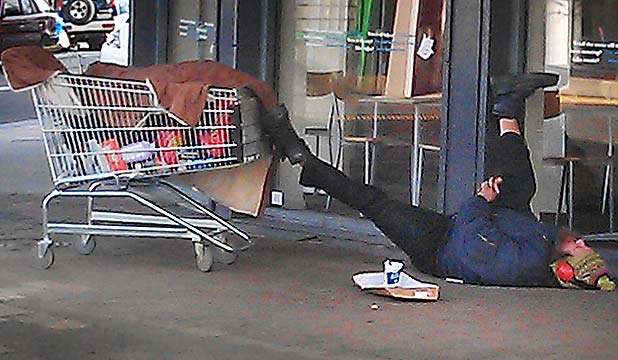
Where will this man get his census form from?
     Are they going to put it in his trolley?


How many homeless people do you know that have a letterbox?  How will they get their codes in the first place?  This is not a new issue.  But it is an issue that affects a larger proportion of New Zealanders than it did during the last census.  Currently, almost 1% of our population is homeless.  We have the highest rates of homelessness in the OECD.  And even if they desperately want to be counted to get the representation they desperately need, how do they get their census codes? And how do people with no permanent abode fill out the 'dwelling' section?

This is what my Mum has to say about this years census:
'It felt more like a caring nation when the census people came to your home.  It felt that you mattered.  Now it feels like society can't wait til the old, poor and disabled die out and then they won't be such a bother.'  I don't think it's hard to understand why she thinks this way.

The Elderly 

This is my Grandma.  She was on Family Feud!
Not only is she tech savvy, but she has good

family support.  Not all folk her age do though.

If they live in residential care - truly, there probably won't be too much of an issue.  Their care provider will likely do it for them.  Because it's kinda the rules (I think?  It is with voting).  But for the independent elderly that may not be as computer savvy as you or I - this may be difficult.  The good thing is that many of them will follow the instructions on the form they got in the post and request the physical forms.  But some of them won't.  Probably a fair chunk will say fuck it!  Why should I, with my arthritic hip/sore knee/busy voluntary schedule, go out of my way to do something for the government that didn't even bother to send someone here for me to talk to!

And for those who get to the library to give it a go - how many will manage to fill out the census online?  With ever decreasing library budgets, it's not like their are a lot of librarians on the floor these days to help those struggling to work the interweb.  And every time they do help someone with their census form that's one less librarian able to do the job they are actually paid for.  I think if I were a librarian this would make me feel a bit stressed and angry.  Most librarians have post graduate qualifications and a lot to do already.  How did this become their responsibility?


Isolated Rural New Zealanders

If you live somewhere like the central suburbs of Auckland, it's easy forget that Fibre isn't everywhere. Actually, broadband isn't everywhere and believe it or not, there are even some areas of New Zealand that have no internet at all.  For people in rural areas, completing an online form is just not possible unless they drive for 45 minutes and stand in a certain position at the top of a hill.  Seriously.  I am sure some of you don't believe me.  I recommend you get your arse to a remote spot in Northland and try to watch a Youtube video.


Of course, again, they can request paper forms.  But, again, this is a two part mission.  People in isolated rural areas will live a long way from post boxes, and may only head into town as needed.  It's not like they can just 'pop by the post office after work' - many of them work where they live - on farms.  And for dairy farmers, it's not always that easy to 'just pop out' with heavy workloads and twice a day milking.


Rural living in New Zealand - doesn't always come with internet
(Mosquito bay, near where I grew up in South Head.  Wireless here,
but not on the Woodhill Forest side.


There are other groups for whom this will not be easy - new immigrants, refugees, those with literacy issues (which make up 1% of our population).  But this post is already long.  So I will stop here.

*          *           *          *          *           *          *          *           *          *          *           *     

So why do I care?  I care because these groups need representation by the census.  I care, because I am concerned that some of our most in-need communities will miss out on funding.  Manurewa local board chair Angela Dalton said that (paraphrased): council receives 90% of its funding based on population count.  Counties Manukau Health figures showed it treated 24,7000 more people than Stats NZ estimated were living in the area, a shortfall of $50,000 in their health budget.  And that was from a census that was not carried out solely online.  I expect that with further lack of representation, under-funding will drastically escalate after the 2018 census.

I do not care selflessly.  This isn't just because poverty and lack of internet affects people I know and love.  This is because in the future, this shortfall will directly impact on myself and my family.  It will impact by way of longer hospital waiting lists, crowded classrooms, increased homelessness and all the other lovely things that accompany lacks in public funding.  The longer we live with rising income inequality, the more this eats away at our society.  And I have to live in that society.  As do we all.

The solution?  I am not 100% sure.  But to start, they could send folk around to pop in and check that everyone has their code, understands what to do with it, and is able to use it.  These days in suburban areas they could even carry an ipad with wireless and help them complete their forms.  They could ensure that there were codes available, and iPads on loan at the Salvation Army and City Mission for a period of time to make it possible for those living on the street to take part in this census.  They could have a system in place where runners could pick up filled in forms in rural areas on a set day.

Yes, all these ideas cost money.  But there are much greater costs.  And our children will be paying them.
Our kids are accounted in this census, but many other kids just like ours, will not be.


* My relationship with gender is complicated.  I believe strongly that gender is a social construct, and by this proxy I probably identify as female (cos feminist, advocate for woman's issues and equal rights etc).  However, I feel a binary view of gender is limiting within our current society - in which case I'd probably prefer to be viewed as non-binary.  But with nice tits.

** While I was sorely tempted to join the many in achieving this phenomenon, I opted for 'rock n roll' as my religion that year.

Friday, 22 September 2017

Some Things People In Poverty Don't Have

I have a sort of hangover from growing up in poverty.  Consequently, there are things people who grew up in other socioeconomic climes expect to be normal for a household that will not be normal for ours.  It's hard to place value on things if you've managed your entire life without them.

I do not think my list will be consistent with other poverty stricken homes - we were just a bit poor.  But I think it might be an interesting insight nonetheless and was inspired by a fantastic article I read yesterday.

1) Tissues
I have never lived with tissues.  Never ever.  I even felt resentful recently buying tissues for Kindy when a tissue donation was asked for (but I did it anyway because those kids are germ bags and we can afford to donate more easily than some other Kindy families).  What is wrong with using toilet paper?  If you come to my house and ask for a tissue and then look dismayed when I say I don't have any, please don't be offended if I flick you a bit of stink eye.  I have offered you paper of a marginally different quality.  You can still wipe your nose with it.  I offered to help with your nose leakage.  I am a good hostess.

The same goes for paper towels.  I have to admit, recently I did start buying paper towels because they are quite handy for some things - especially now we have kids, but I cannot say I don't look at them and see them as a reminder in my class shift.  Even if they are Budget brand.

2) Icecream
We don't carry icecream.  We never had icecream growing up unless we were visiting Grandma Thompson's house.  Then we'd have a slice from a cardboard box of vanilla icecream after lunch as was her tradition.  And we did have it on special occasions.  The no icecream thing wasn't just a money thing - it was a living-in-an-isolated place thing.  Like, it would melt by the time we got home so it was pretty pointless buying it.

When I was a teenager, a while after my parents separated, we were slightly better off financially.  Mum would buy icecream (neopolitan) - I think it was to make up for our less privileged childhood - but it would sit in the freezer uneaten until it went icy.  Well, sometimes the chocolate would get eaten but not the rest.  The thing was that we were so unused to having it that it felt weird to have it so we would forget we had it, or feel strange about having it.  Icecream was just stressful.

Today, we don't usually* have icecream in the freezer because we have a tiny freezer which needs to accommodate other more important items - like frozen meals and sausages (now that I've bred minions that eat mostly sausages).  And because it does still kinda stress me out.

3) Oranges, grapes and berries                                    Gooseberry gathering

I think this may still resonate with maybe the older generations.  I used to just have oranges at Christmas.  I'd get one in my Christmas stocking and it was a treat.  Consequently, I think I'm programmed to see oranges as a rich person food and something only for special occasions.  I like oranges.  I don't think they're the best fruit around, but they are nice and refreshing and enjoyable.  Our house has an orange tree.  It produces pretty good oranges.  I STILL struggle to eat them.

And grapes and berries** were totally the realm of the rich.  We only had them at parties hosted by other people and for fear of eating too many and being reprimanded I just left them alone.  I struggle to eat grapes now (I actually hate the texture of their skins and pips), but berries have come a little easier.

This has been aided by my decision to start a berry patch.  After realising they grew well under the orange tree, and seeing how much our kids enjoyed picking them (as I also did as I child) I thought this a marvelous plan.  It currently homes cape gooseberries, blueberries and a thornless boysenberry, and we've JUST put in strawberries - so will hopefully have a berryful Summer.  We can do this though because we are lucky to be home owners and live somewhere with good soil.

4) Any green vegetable we didn't grow ourselves
Apart from frozen peas (which I despised).  Otherwise we just had silverbeet and in Summertime sometimes beans.  I don't think I had broccoli until I was a teenager.  Or spinach.  I adore both.  I still won't buy either unless they hit a magical price number I have stashed in my brain.  If it's on special I will buy extra for my Mum.

The plus side of this is that as a grown up I have a garden abundant with simple greens - silverbeet, spinach and kale.  And instead of icecream our freezer teams with blitzed silverbeet - handy for making lasagne, ravioli and saag aloo.  And free and nutritious.

Our silverbeet and kale (today)
5) Store bought biscuits
This will have been a combination of having not a lot of money, and also being country folk who grew up in the women-bake-for-the-shearing-gang kind of mentality.  Mum made bread, scones, pikelets, peanut brownies, louise slice, albert slice, ginger slice, animal biscuits (my childhood favorite - chocolate with a hint of spice) and rice bubble squares.

We had no need for such things as bought biscuits.  I felt pretty spoilt.  Shop biscuits were reserved for times of year like Christmas, where someone in the family would no doubt gift us one of those Sampler boxes and we'd argue over who got the biscuits with real chocolate on them.

6) Chicken
Are you fucking kidding me?  That shit was expensive!  Besides sausages and mince, I don't think we really bought meat.  We just got whatever we were allowed from the farm.  And a few times we kept our own pigs, so had pork and bacon and stuff.  But chicken was for fancy people because they came from the shops.  Because if you've ever eaten one of your hand raised chickens you will know that they taste very different to what comes from Tegal.  And not in a good way.


The teeny tiny primary school I mostly went to.  Lots of happy memories in the library here.

7) School trips & Extra curricula activities
Kids at my school went to swimming lessons.  They studied piano and gymnastics and dance.  Living in an isolated area on a limited income meant this was just not possible for our family.  My extra-curricula time was spent in the school library reading or playing computer games or writing kiddy novellas whilst Mum cleaned the school (she was the cleaner).  When a brownie troop started up locally though, I was allowed to go!  This was a definite highlight of my childhood.  I felt very lucky.  There were still no local extra-curricula activities for the boys in our area.

We didn't miss every school trip.  But we couldn't afford to go on the bigger ones.  The senior school at my teeny tiny primary school went to the Whakapapa ski fields one year.  I couldn't go.  I was not alone, but there were only a few of us who couldn't (it was a high decile school).  Things like this fed into the thinking that we were different to our peers - those shared experiences that we missed out on.

I have still never been to the snow.  Truthfully though, I don't think I'd like it.  I suspect it's very cold.

*           *            *            *           *            *            *           *            *            *           *


So these are the things I remember.  I had a pretty good childhood, and would have actually been relatively unaware of most of the things my parents struggled with.  We also didn't often eat out, or have sweets, or have takeaways - but this hasn't really seemed to impact on my psyche too much.  I remember that food was harder to come by when Dad took a break from farming for a bit (no free farm meat) and our diet shifted significantly.  We were lucky that my parents often worked in jobs where they got food on the side - orchards, market gardens and the local venison farm Game Meats.

Mum and I have talked about this quite a bit.  And I think it would be helpful to contrast my list with some of the things she finds hard to afford now living alone on a benefit today.  I have summarised a little as her list was understandably long. 

1) Choice
When you are poor, you have less choice.  It doesn't matter how ethical you are, or wish to be - there is no way you can afford things like eco-products or free range eggs or olive oil.  You can never afford to buy premium brands because every cent counts and is counted.  Mum usually cooks a family size meal and eats the same thing for dinner 3 - 4 nights in a row as she has little freezer space to store meals.  It is boring, but it is the most affordable way to eat nutritious and filling meals. 

And if you are tired and don't want to cook, you can't just get takeaways or go to a restaurant because it's just not financially feasible.  As a treat Mum will sometimes get some hot chips, but that's about it.

Hot chips are a treat

2) Technology
Internet, smartphones, Freeview - these are all things Mum doesn't have that most of us take for granted.  We tried to help get her set up with Freeview - bought a Freeview box and a newer TV (she had an old style boxy one) and a super aerial thing, but because of where she lives - still no Freeview.  It costs about $300 to have a proper aerial installed which she can't afford - and we can't afford to do for her either - especially because it's for a rental property that she may have to leave at any given time.

And internet... To use this at home, she needs a smartphone as this is the only affordable way she could manage it.  Mum can't afford to buy a smartphone.  Yes, these days you can get them for $40 - but this is still $40 she does not have, and is double the price of a non smart-phone.  And yes, you can get a basic Skinny package for $16 per month which includes 1GB of rollover data - but that's still $4 less per week to spend on food.  This is still out of reach for lots of people.  Yes, Mum can access the internet at her local library (and does).  This is not remotely the same as having internet on hand 24/7.

3) Snacks
It is hard enough to afford meals let alone things to eat in between.  You just have to eat less.  Mum doesn't eat breakfast either (although to be fair, I can never remember her eating breakfast - might be something similar to me and oranges).  And even though we live in a country which grows some amazing produce, fruit is unaffordable - especially outside of the peak harvest seasons of Summer and Autumn.  So while this should be a good snacking option, it's just not easy to do for half of the year.

4) Cleaning, sanitary and skin care products

When you have a teeny wee food budget, buying things that are non-food can cut out a lot of money you could use on veges or bread.  Mum also has a citrus allergy, so can't buy a lot of the cheaper cleaners or even basic hair care products because they are lemon, grapefruit or lime based and cause her skin to peel off and give her a hayfever type reaction.  She doesn't have to buy fancy ones, but just regular priced cleaners are usually at least $4, which is still unaffordable.

And moisturiser?  Even the cheap one that we use (which is Olay for sensitive skin) costs about $12 a bottle.  And even if that bottle lasts for ages, you still have to come up with the $12 in the first place.  Which might mean buying no eggs or cheese for two weeks (which is Mum's main source of protein as she is vegetarian).

5) Money for leisure
It is hard to have hobbies, because most of them cost money.  Mum can't afford to go swimming let alone join a gym. Even baking biscuits costs extra - especially with the cost of butter these days.  She cannot go 'get her hair or her nails did' - she can't afford haircuts at all.  Same goes for shopping for new clothes.  She cannot afford to travel - even locally - because petrol is expensive.  Mum can barely afford craft supplies from $2 shops to make things at home with***.

6) Prescriptions and Pet care
Mum has a permanent disability but is not on a sickness benefit because they no longer exist (they have been absorbed into the 'jobseekers benefit').  And even though she has had three failed surgeries (and one upcoming), her GP will not sign her off onto an invalids benefit even though simple things - like walking - can be difficult for her on bad pain days.

Because she has no dependents, in order to be eligible for the prescription subsidy, she needs to get 20 prescriptions per year for herself.  This is $100 worth of prescriptions - and that's just if the medications are already subsidised.  This is on top of GP costs.  Sometimes she cannot afford to fill her scripts and has to wait, in pain, until she can afford to.  This is not uncommon for people on benefits.

Pets are important for our well-being        

Equally, taking her cat to the vets is very difficult.  Vet bills are expensive and unpredictable (we spent over $3000 on a rabbit who was then euthanised...)  I do not feel it is fair to say poor people cannot have pets.  Mum lives alone.  Humans need comfort from other animals.  Remember Maslows monkeys?  Having pets is now thought to promote longevity in humans and more and more hospitals and rest-homes now use pet therapy.  When life is hard, a little warmth is important.

7) Electricity and water
Speaking of warmth, Winter is especially hard because it is cold.  Mum is aware of how much power costs, so uses it sparsely, which means she doesn't use a heater even though her home is cold and uninsulated.  The same goes for water.  Washing is done sparingly and showers are minimal.

*           *            *            *           *            *            *           *            *            *           *            *           
So yep.  It's a pretty grim picture, and Mum's current concerns make my childhood ones appear silly.  The truth is that our cost of living has skyrocketed, and benefits and incomes have not kept up.

Whilst there has been much debate about this number (and I'm going with the version from before the current government changed their parameters) 290,000 children currently live below the poverty line in NZ.  This number The poverty they experience will be well beyond that I experienced growing up - likely much harder than what Mum experiences.  She only does ok because she has support**** from her family. 

There is a massive chunk of our society who do not get to experience the kind of lives many of us take for granted as 'normal'.  And as inequality grows due to numerous factors, the future of these children, and their families seems bleak.

I am 36 and I still can't eat oranges.                                       Oranges on our tree
Something needs to change.


* Sometimes we do because Murray likes to make icecream with the kids.  Because we are lucky and can sometimes afford fancy icecream ingredients like cream and eggs.

**Besides blackberries, which in the 80's grew abundantly unsprayed on many a roadside and were delicious. 

*** Mum's free leisure activity is reading books and getting out documentaries from the library (which are also free).  She also does the book run for her local rest home and spends time with the residents there.  And she helps me with the kids once a week and (when well enough) Grandma with her garden.  In spite of having little financial wealth, Mum is an extremely giving person.


**** Mum is extremely grateful to receive varying forms of support from her family.  I am extremely grateful to our family too, as the support we can offer Mum is there -  but it is more limited than what would be ideal.

Monday, 22 February 2016

On how the rich stay rich, and the poor stay poor in NZ


So I've been thinking about this post for a while now, and I KNOW no matter when and how I write it I'm going to miss things out and get things wrong.  But I need to write it, so I'd best get on with it.

There are many every day things that simply help our wealthy prosper which are simply out of reach for those on lower incomes.  They are so obvious that a lot of people seem to be oblivious to their existence, or at how massive their impact can be long term.  So I thought I'd write about just the few I think about often.

1) Savings Interest Rates
While I fully understand the whole 'more you save the more you earn' thing (as can invest more/return more), I also KNOW that those who are poor cannot usually afford to save - everything they make is eaten up in costs of living. 

Lets look at the following examples:
The Co-operative Bank is currently offering 3.6% PA for short-term term deposits (4 months) of $5000 or more.  So if I had a spare $5,000 to put somewhere for four months, I would make $60 for doing nothing at all.  And lets say I have a spare $10,000 to put somewhere for five years.  Currently, ASB is offering 4% PA for this - in this case I'd make $133 every four months again, from doing absolutely nothing at all.  And if I put $100,000 away I'd make $1,333 in that same time period.  So I get paid about $83 a week for doing sod all.

So the bank will pay you for them to just hold onto your money - more if you have more money.  And this is just looking at small, safe investing - not even thinking about stock exchange or high risk investment.  So people with enough money to spare get given free money from the bank, while those with just enough get nothing (and those in overdraft pay fees on what they owe).

2) Kiwisaver
Poor people just can't afford it.*  That's just the truth.  Sure, it's a great plan and can get you free money if you use it in the best possible way, but that's not an option for a big chunk of us.  For many families even the minimum of 3% is enough of a chunk of money to make a difference in daily life.  Let's say I work 40 hours per week for minimum wage.  Kiwisaver takes up almost $18 of my after-tax income - so I get $479.35.  The average rent for a three bedroom house in Auckland is $482 - which exceeds my wages.  So even if my partner works part time (cos looking after children for instance) and earns about $250 after tax (minimum wage, 20 hours) we'd only JUST be able to afford to make ends meet week to week.  And that extra $18 I earn (plus the $8 my partner would earn) would actually make a big difference in what we could feed our family (or whether we could afford to have internet/a running vehicle/insurances or not).

A few years ago my MIL asked me if I was getting my 'free' annual government contribution of $1000 odd dollars.  I told her I didn't make the payment thresh-hold.  She asked me why I didn't top up to that thresh-hold.  I told her it was because we couldn't afford to do that and still pay rent/eat food.  She just didn't get it.  Again, there is free money for those who can afford it - but not for those who can't.

Yep, it's a great plan and we used my contribution to help buy our house, but Kiwisaver is just not viable for everyone.  So the governments assumption that everyone can 'afford' to have Kiwisaver is just bizarre.

3) Bulk Buying
Many years ago now I worked in an inbound/outbound call centre which did work for a large range of clients.  One of these was Mana**, which at the time worked to help Maori find employment and generally do better/feel better in life.  At that time they had a series of ads running which showed how people had bettered themselves through using the program.  In one, a Mum of a large family talks about how she could only afford to buy toilet paper one roll at a time.  I was not usually on the inbound phones (I worked outbound, then was a teamleader then supervisor) but did small stints on our general inbound team when necessary.  On one such occasion I had the pleasure of being abused by a woman who disbelieved what was purported by this ad for Mana as 'Everyone knows it's cheaper to buy toilet paper in bulk.  It can't be true, it makes no sense'.

It is true that it (usually) is cheaper to bulk buy.  What this woman couldn't understand/believe is that someone could only have the less than $1 to spend on toilet paper per week rather than the $3 that would allow them to purchase many more rolls of toilet paper in a multipack.  For me this is entirely believable.  For those who live paycheck to paycheck, literally every cent counts.  What was implicit in what the woman in the Mana commercial was saying was that if she spent any more on toilet paper, she couldn't have afforded to buy certain food items, or pay rent, or buy petrol.  While I can see how this could be unbelievable to those who've never encountered this type of quandry, it doesn't make it any less real.

In recent times, with all the talk about our hundreds of thousands of kids living below the poverty line I've heard the same line of thought around Weetbix.  But as shown here, you can't purchase single serves at as low a cost as you get when you guy these products in bulk.  And for many, bulk buying items is just beyond the ability of the weekly budget.***

4) Vehicle Ownership
Cars not only cost a bunch to purchase (for those in lower income brackets even the low thousands is pretty unreachable), but cost a lot to maintain.  We are a single income family who earn a decent amount, but I still don't see multi-car ownership as a financially viable option for us.****  I often encounter shock horror at this fact: 'You mean, you are home with two kids and have no car - how do you get anywhere/do anything/stay sane?'  Um, we get by.  We use public transport.  We use our legs.  We appreciate what we have.  And we do have a car.

But having a vehicle gives you a lot of flexibility.  You don't have to base your employment on proximity to transport routes.  Or your shifts around when you can get to work.  You can shop around for the best bargains.  You can send your kids to the most suitable Playcentre/school/kindy rather than the closest one.  Same with extra curricula activities.  You save a lot of time, which you can then spend doing whatever you like (including, working to earn more money).  Having flexibility means you have more options - which can mean better earning (or saving) ability.
 
5) Timely Payment 'Incentives'
We save around $18 a month on our power bill just by paying it as soon as we can.  We can afford to do this because we earn a decent amount of money, and can put the money aside for our bills to do so.  So we save $216 a year just because we can afford to pay one bill on time.  Or around $4.20 a week - enough to bulk buy toilet paper every week if we wanted and have a little extra to spend on something else.
 
6) Internet
With more and more services switching to online only, this increasingly impacts on those Kiwi's who can't afford to have internet at home.   Yes, there are increasingly public places that allow free internet access (public libraries), but I imagine many people are wary of accessing many services via a public access computer - for instance banking facilities or personal accounts (email, social media) - particularly people who don't have a lot of online experience - which will be people who can't afford to have internet at home. 

There are many things I enjoy online at home which enable me to better manage our finances: online banking, mobile account management, access to the latest news and weather (affects whether I wash clothes or not, which affects how much I spend on laundry powder - and many other random things), social media (which allows me to access help, support and trade via friends, family and the broader community), shopping and price comparison websites.  I also do surveys online for vouchers I can spend online - I earned around $350 last year doing this - which is about $6.70 per week.  It really took the pressure off us at Christmas as I used it predominantly for gift buying - but for a family in a trickier situation than us it could mean the difference between being able to afford new shoes and jackets for their kids when they need them - or not. 

7) Insurance
Having grown up quite poor, I still struggle with how much we spend on insurance.  For me, it feels like throwing money up into the wind - most of it floats off into the ether.  And it's not a small amount.  We spend as much per week on various insurances (including house, home and contents, vehicle, life [for both Murray and I] and health [for all of us]) as we do on a months unlimited broadband.  That is an entire food budget (or double a food budget) for some families.

But it's useful.

Life insurance mean that if either of us randomly die the existing one of us can pay off the mortgage, and have a little left to pay for the funeral.  Whilst I don't expect this to happen, the thing with accidental death is that you don't.  It's worth the peace of mind for us.

Health insurance is probably even more important - instead of having to wait around on public lists for random things we can go private for consults and surgeries.  This means there's less impact on our health and wellbeing (and on our work/ability to work).  Both Murray and I have both used specialist medical services in the past few years - both for unexpected things.  Totally worth it for us (especially me with all my random bungness).  And while it costs us, long term I expect it to save us much that you can't really put a price on.

But insurance is a luxury.  When you are living on the bones of your butt and can barely afford to make rent payments or put food on the table it's just not plausible to have it.  Which means that when things do go wrong, life can become even tougher: your house is robbed - you have to start from scratch with all your appliances.  You crash into an expensive car - you have to organise part-payments to cover the costs which eats into the food budget.  Not having insurance can be very expensive.

8) GST
GST impacts more heavily on those who earn less as those on smaller incomes usually have to spend it all on goods and services to get by.  Let's say someone earns minimum wage working 40 hours per week and doesn't have Kiwisaver - that's $497.05 cash in hand per week.  Of that, lets say they spend $480 on their bills, gas and food (being conservative) - that's $72, or 14.48% of their wage.  Someone else earns $60,000 PA (and have Kiwisaver and a student loan) - that's about $796 per week cash in hand.  Because they earn more, lets say they spend more than the first person - but try and put aside about 20% of their income.  That means they are spending $95.52 in GST per week.   So while they're paying a larger amount than our first person, that's just 12% of their income.  This is why increasing GST has a greater impact on those on lower incomes.

9) Buying things out-right
When you have money, or savings - you can do this magical thing where you go to a shop, and purchase a large item, like a fridge or couch without using finance.  Which saves you at least $80+ per application (and if you have a vehicle, or a friend with a vehicle, you may not have to pay for delivery either).

10) Putting more than the minimum on the mortgage
Many NZers in lower income brackets won't ever be able to get a mortgage.  But for those who do, their mortgage will probably end up costing them more in interest, than those who earn more.  Here's an example from stuff.co.nz:

'A young couple buying a $400,000 home over 30 years with a starting deposit of $50,000, and assuming a long-term interest rate of 8 per cent, will end up paying interest of over $574,000, more than the price they paid for the home.' ... If they opted to pay just $10 a week more than the minimum repayments, they'd cut their total repayments to the bank from $809,950 to $783,500. ' 

That's a saving of $26,450.  I put the same information into the mortgage calculator in Sorted.  If you can put an extra $20 on the mortgage per week you save just over $80,000.  If you can spring to $100, you can save around $255,000 in interest over the lifetime of your mortgage.  That's a whole buttload of money. 

*          *          *          *           *          *          *          *           *          *          *          *          

Just to reiterate, these are just a few examples of things I notice in daily life.  There are many, many more things that contribute to this broadening gap between rich and poor in NZ.  The purpose of this post is to make some of these things visible to those who have never had to think about these things.  I found this a very handy tool to help work out the figures I've used, but I'm no expert at accounting, economics or math - so these may not be perfect.

I just want people to think, and realise, and be grateful for what they've got.  And not assume that all wealth is garnered through hard work, and all poverty garnered through lack of it.  There are some very practical things which help keep those with little at the bottom of the economic food chain, and those with more at the top.


* And yes, there are poor working folk in New Zealand.  Many of them.

** I hope I don't get sued for this, confidentiality statements I signed back then and all, but I don't think either company exists any more, plus not saying anything negative about anyone anyway.  Fingers crossed!

*** And yes, these people could shop monthly - but they can't.  Cos they'd need a large sum of money at the outset for the first month.  Which never happens.  As they never have any money.  And if they try and save that money they will have no food for the first month.  And if you don't eat for a month, you die.

**** I also personally feel it is unnecessary for us to own a second car.  We live a mere 20 minute walk from a mall and supermarket.  We are close to major bus and train routes.  We are healthy and able.  It is good to teach the kids to get out and about and that they need to work for what they have.  And it's much better for the environment.  I personally feel the benefits we get from not having a second car far outweighs the benefits of having one.